1. Introduction: Enmediating the Game Boy
[1.1] A musician releases an electronic music album. A coder writes a horror game. An artist performs a music gig, combining presequenced music with live sounds. These acts are perhaps unremarkable, yet what renders them theoretically significant is the platform at their core: the Nintendo Game Boy. Their very possibility rests on a fundamental reconfiguration of the Game Boy's function, from mass-market gaming device to a locus of fan-driven cultural production.
[1.2] Launched in 1989, the Game Boy superficially remains virtually consistent to this day, its instantly recognizable form factor and green-tinted LCD screen making it one of the most distinctive objects in early handheld gaming. To look merely at its physical form, though, obscures the systems, structures, and power relations inherent in its past and present ecosystems. Here, we examine the homebrew and maker scenes that support the Game Boy today, and the fan communities that have rejuvenated and extended its life and capabilities over the past two decades.
[1.3] We propose the concept of enmediation as a productive framework to understand this transformation. Enmediation builds upon and critiques Bolter and Grusin's notion of remediation, which posits that new media refashion or absorb earlier media forms (1999). While remediation is often visual or representational in its focus, enmediation, as outlined by Berry (2013), directs our attention to the infrastructural and ecological shifts that accompany the migration of content and practice across platforms.
[1.4] Marshall McLuhan, in 1964, famously claimed that "the content of any medium is always another medium" ([1964] 2001, 8). He suggested that "the content of writing is speech, just as the written word is the content of print, and print is the content of the telegraph." (8). When so-called new media began to predominate, Bolter and Grusin extended this to argue that such digital media often simulated earlier media forms: digital photography remediating the analog photograph, for instance (1999).
[1.5] Berry, however, critiques this lineage for being too focused on surface-level resemblance, overlooking how radically different software infrastructures can present similar user experiences (2013). For example, video content can appear effectively identical, whether viewed as-broadcast on digital television or on YouTube, but the underlying forms and infrastructures are vastly different.
[1.6] Berry suggests that transformations of a medium may be better understood as consisting of a demediatory and an enmediatory phase. This allows us to consider the point when a medium ceases to exist in its previous form and is enmediated within a new framework. He writes that enmediation sees the "securing of the boundaries related to a format, that is, a representation or mimesis of a previous medium—but it is not the 'same,' nor is it 'contained' in the new media." (2013, 33)
[1.7] In contrast to remediation, enmediation attends to the material recontextualization of platforms. It marks the re-embedding of a preexisting medium within new technical and cultural systems, maintaining some formal continuity but undergoing a shift in its underlying technologies and its social and creative affordances.
[1.8] The Game Boy's transition from a closed, proprietary system to an open platform for fan creativity illustrates this shift vividly. While during the 1980s and 1990s fans would play the games released within Nintendo's walled garden, today's playful environment extends to fans creating the games themselves. Tools like GB Studio (https://www.gbstudio.dev/; https://gbstudiocentral.com/news/gb-pixel-art-jam-2023/), developed by and for fans, enable a new ecology in which power is decentralized and production is democratized. This is not a new phenomenon: The lineage of easy development frameworks accessible to inexperienced programmers extends past the Game Boy to older tools such as Graham Yandle's Quill from 1983 (Gunness 2000) and, arguably, the earliest of the type, Jochumson and Carlston's The Arcade Machine from 1982 (Sandberg-Diment 1983). For the Game Boy, enmediation entails not just visual continuity but a fundamental change in who controls the means of production.
[1.9] This theoretical lens aligns with critiques of power within media ecologies. Michael Shamberg's Guerrilla Television (1971), for example, envisioned a radical democratization of broadcast media through the adoption of personal video production equipment (Merrin 2012). In a similar vein, the Game Boy's enmediation involves a reworking of its creative circuits, once monopolized by Nintendo. It results in the empowerment of individuals and small communities to produce content outside institutional constraints.
[1.10] Historically, Nintendo's tight control over its platforms exemplified a closed media ecology, enveloping both software and hardware. Every game was vetted and licensed, and the consoles themselves were protected by patents and registered designs. In the case of the Game Boy, enmediation represents a reversal of that model, shifting from an ecology of permission to one of possibility. No longer are the constraints of the system predominantly commercial, institutional ones; rather, it is now the hardware that openly challenges and invites creative intervention.
[1.11] As such, Game Boy fans act not just as consumers but as enmediatory agents, reconfiguring the console's function within a radically altered media landscape. Therefore, in this article we position the Game Boy not merely as a site for fan activity but as a platform that has itself become an object of fandom. This distinction draws on and extends recent work on platform fandom (Alberto et al. 2024), by proposing that fandom can emerge not only on platforms (Morimoto and Stein 2018; Binnie 2024) but can have as its focus the platform itself (Lima and Varga 2023). Game Boy fans do not just use the console: They reimagine its purpose.
[1.12] This approach resonates with early work in platform studies, such as Bogost and Montfort's analysis of the Atari VCS (2009), which treats hardware constraints and creative practices as mutually constitutive. The Game Boy, too, is a case in which technical and cultural affordances, and fan communities, intersect to form a dynamic media ecology.
2. New creative tools on the Game Boy
[2.1] Once a tightly controlled commercial object, the Game Boy has been repurposed into a platform for grassroots creativity through homebrew tools. These tools exemplify how software development has shifted the ecology of production around the Game Boy, breaking away from top-down corporate control.
[2.2] Nintendo's design philosophy has long emphasized low-cost, readily available technology, a fact which unintentionally primed the Game Boy for later creative repurposing. Its underlying architecture was already outdated at launch (Copetti 2022), but this allowed its simplicity and portability to lay the groundwork for future reappropriation by fans.
[2.3] Nintendo's choice to use an 8-bit Z80-like processor (a Sharp SM83) as the core of the Game Boy meant that it shared a technical lineage with earlier home computers (Lee 2024), which were themselves part of an open, hackable culture. Versions of this processor had been used in the Sinclair ZX Spectrum (1982–89) and the Sega Master System of 1985. By the time Nintendo decided upon the Game Boy's processor, common domestic machines had moved to 16/32-bit hybrid designs. Thus, the Game Boy existed as a paradox: a simple, closed system with latent open potential. It is precisely in this paradox that its enmediation resolves, reinterpreting constraints as creative affordances.
[2.4] Fan experimentation uncovered unused graphic and audio capabilities in the hardware, revealing a latent creative potential: the discoveries that the Game Boy architecture enabled additional shades of gray and an extra sound channel, beyond those used in commercial releases, were notable examples (https://www.reddit.com/r/Gameboy/comments/3sxtjz/could_the_game_boy_produce_more_than_4_shades_of/). This process of discovery illustrates an enmediatory process, where an old medium is not simply preserved but restructured into a new creative ecology. This echoes Stokes's theory of constrained creativity (Stokes 2001): Far from limiting expression, the Game Boy's restrictions have catalyzed artistic innovation. The handheld device became a canvas for creative problem-solving, where limitations were not obstacles but productive parameters.
[2.5] Nintendo's own releases, such as Mario Paint on the Super Nintendo (1992), foreshadowed fan creative activity. This game allowed not only image creation but also music, including a relatively powerful sequencer in the form of the Composer, still in use by artists today. Such products introduced official, though limited, creative tools that hinted at the console's expressive potential. Trippy-H, a musical mini-game found in the software of the Game Boy Camera (1998) included not only sequencing but sound editing, and sparked the realization among users that the console could be a compositional tool. This marks a transitional moment: Nintendo's recognition of the Game Boy as a site for creativity, not merely consumption. Like analog photography tools, the Camera's low resolution offered a distinct visual language that users embraced. However, it remained within Nintendo's framework: Full enmediation was yet to occur. Independent artistic extensions of the Camera's capabilities, such as filters (Björn 2020) and custom lenses to achieve astrophotography (Cockfield 2022), though undeniably examples of fan innovation, did not fundamentally alter its media ecology. These practices are best understood as extensions of the device's official affordances, not as a shift in ownership or authorship.
[2.6] Similarly, software like the sequencer Pocket Music (Wilks 2002), a reimagining of an existing program for the PlayStation, pointed toward new creative uses, but was still constrained by commercial distribution and platform licensing. Nevertheless, it planted the seeds for grassroots development, especially as commercial support waned.
[2.7] Nintendo's shift away from the Game Boy with the release of the DS marked a key moment of demediation. No longer commercially viable, the Game Boy platform entered a space where fan experimentation could flourish. The abandonment signaled a retreat of corporate interest and thus a loosening of control, the process of demediating the Game Boy and transitioning it away from being a commercial product having begun.
[2.8] The emergence of reprogrammable flash cartridges is central to the Game Boy's enmediation. These tools enabled fans to bypass official distribution channels, reclaiming hardware for their own purposes—a shift that illustrates Berry's claim that enmediation secures a new framework distinct from the original medium. Initially, Nintendo viewed this challenge to its authority seriously, seeking prosecutions against flash cart distributors (Fahey 2003); yet once the platform was no longer defended commercially, creative freedom expanded. While early cartridges required an external programmer to write software, online communities featured a number of "cart slingers" who, for a small fee, would send users a cartridge flashed with the software they requested. This proliferation of reprogrammable cartridges and the rise of online communities further democratized access to the platform. The enmediated Game Boy thus became a space where ownership was not just technical but cultural.
[2.9] As new creative possibilities opened up, the Game Boy evolved into a hub for chiptune, homebrew games, and digital art, as will be discussed in the following sections. Its legacy became one of subcultural innovation through limitation, a transformation that highlights the power of fan communities as enmediatory forces capable of reimagining commercially obsolete technologies.
[2.10] Enmediation, then, is not merely a post hoc theoretical lens but an active process of cultural redefinition. Through it, the Game Boy ceased to be a commercial product and became a collaborative platform for distributed creativity.
3. Chiptune in your hand
[3.1] The reconfiguration of the Game Boy as a musical instrument illustrates the platform's enmediation in striking terms. Originally designed for play, not performance, the Game Boy has been refashioned into a sound synthesizer at the hands of creative fan communities. This transformation exemplifies how new ecologies of practice emerge once corporate restrictions are lifted, enabling cultural production to flourish in unanticipated ways.
[3.2] The evolution of the chiptune community illustrates Berry's concept of enmediation as the securing of a new framework that is not merely a replication of previous media, but a recontextualization within different logics of use. As fans created and shared music-making software for the Game Boy, they reconstructed the device as a creative tool embedded within new cultural systems of meaning and value.
[3.3] Nanoloop, one of the first and most influential components of this enmediated toolset, was the first specific music creation program solely written for the Game Boy, enabling the user to control a drum machine–like interface using the console's own buttons (https://nanoloop.com/one/). Developed in 1997 by Oliver Wittchow, originally as a university project, it abandoned Nintendo's sanctioned development practices and operated independently within the console's hardware. In doing so, Nanoloop reframed the Game Boy not as a closed system, but as a lo-fi handheld synthesizer—a shift from remediation to enmediation.
[3.4] Nanoloop had its first public performance in 1998 at Cologne's Liquid Sky club (https://nanoloop.com/about.html). Wittchow won a record deal, and a 7" single titled "Nanoloop" was released by XXC3 in 1999, the first ever chiptune to be explicitly written and produced for an established record label. Commercial production of Nanoloop began in Germany in 1999, moving a few years later to China, where looser IP enforcement allowed Wittchow greater control of the project. The device went on sale worldwide in 2000. Wittchow's record deal and single release, we argue, marked a significant moment in the Game Boy's enmediation and its entry into a wider music industry under new creative paradigms.
[3.5] The release of Nanoloop-only compilations and the development of Nanoloop Two for the Game Boy Advance further entrenched the Game Boy within this emergent musical ecology. The physical design of the Nanoloop Two cartridge, with its compatibility with Lego bricks, exemplifies a chiptune community with a playful, modular ethos (https://nanoloop.com/two/). It highlights the aesthetic and functional reimagining of hardware in line with new artistic values.
[3.6] In contrast, LSDJ (https://www.littlesounddj.com/lsd/), developed by Johan Kotlinski and first released in 2000, offers a tracker-based interface that resembles coding more than playing. While Nanoloop can be seen as an instrument that invites improvisation, LSDJ is an interface that offers full control and precision over every parameter. Together, these tools reflect distinct but complementary visions of what an enmediated Game Boy can enable: one oriented around performance, the other around compositional depth.
[3.7] The popularity of LSDJ, and the communal practices that grew around it, reflect the maturation of an entire media ecology based around music production. Mods such as Prosound, seen on the Game Boy (figure 1) enable a standard 3.5mm auxiliary output to be taken directly from the console's internal sound circuit, thus increasing the tone and quality of the output (Park 2019). So prevalent was LSDJ's use that the file name "My First LSDJ.mp3" became a meme within the chiptune community, spawning actual releases under that title (https://kulor.bandcamp.com/track/my-first-lsdj; https://soundcloud.com/derris-kharlan/my-first-lsdj; https://jellica.bandcamp.com/album/my-first-lsdj). This reflexive, recursive self-awareness exemplifies the depth of cultural production enabled by enmediation.
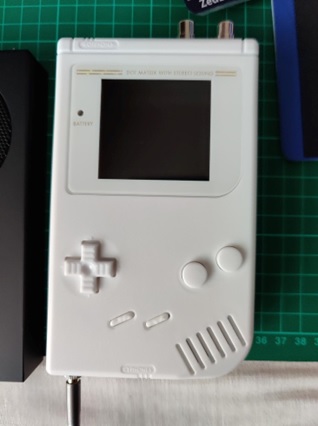
Figure 1. A modded Game Boy DMG containing a Prosound and 3.5mm auxiliary mod (photo provided by Price [author], July 2024).
[3.8] Tools like Nanoloop and LSDJ not only redefined what the Game Boy could do; they redefined what it was. Through their development and adoption, the Game Boy ceased to be merely a legacy gaming device and became a node in the creative network of chiptune, one that is living and evolving (McAlpine 2018). These tools represent the technological infrastructure that enabled the Game Boy to be enmediated, forming the backbone of a platform fandom rooted not in consumption, but in co-creation.
4. Performance tools and Pixelh8
[4.1] While the physical hardware of the Game Boy is immutable, the console's enmediation by creative fans allows a range of possibilities to be explored that were restricted by Nintendo during its commercial life. We have already shown how enmediation can be seen as the repurposing of a medium within a new ecology, and the development of performance software for the Game Boy underscores how fans have not only recontextualized the console but extended its capabilities beyond what its original creators imagined. Despite the device's fixed hardware, fan intervention has introduced modes of real-time musical engagement that reflect a deep shift in its sociotechnical function.
[4.2] Tools like Music Tech (https://web.archive.org/web/20070908185056/http:/www.hiddenyouthrecords.co.uk/p8musictech.htm) demonstrate this evolution from sequencing to performance. While software such as Nanoloop and LSDJ were already enmediating the console as a compositional tool, Music Tech enmediates it further, into a tactile, expressive performance instrument. By streamlining the interface and enabling real-time control, the software reinforces the idea that constrained hardware can still yield expansive expressive potential.
[4.3] Stark (2011, 19) suggests that electronic instruments are more compelling in live performance if the audience can observe the performer's physical engagement. In this context, Music Tech addresses a limitation inherent in early Game Boy music software: the opacity of performance. The move from stringing together hexadecimal commands to pressing visible buttons in real time transforms not only the audience's perception, but also the artist's agency.
[4.4] This focus on immediacy also speaks to enmediation as a democratic process. Music Tech lowers the barrier to entry, enabling novice musicians to engage creatively with the Game Boy. It is perhaps no coincidence that its creator Matthew Applegate, known as Pixelh8, is an educator working with children (Fossett 2022). Here, the console is no longer the domain of elite coders or seasoned musicians; it becomes an accessible tool for collective learning and expression.
[4.5] As the Game Boy's enmediated identity expanded, so too did the demand to detach its sonic potential from its physical form. Software such as mGB (https://github.com/trash80/mGB), coupled with interfaces such as the Arduinoboy seen in figure 2, enable the console to function as a full MIDI-compatible sound module (https://github.com/trash80/Arduinoboy). For a platform that "enjoys peculiar prominence among contemporary chiptune artists" (Driscoll and Diaz 2009), this marks an important moment in the enmediation process. The Game Boy's cultural and creative value had become so embedded that it warranted integration into broader, professionalized music workflows. The Arduinoboy repurposes the Game Boy's internal logic to make it speak the language of professional MIDI systems, thereby situating it within entirely new production ecologies. The platform's transformation is now both symbolic and systemic.
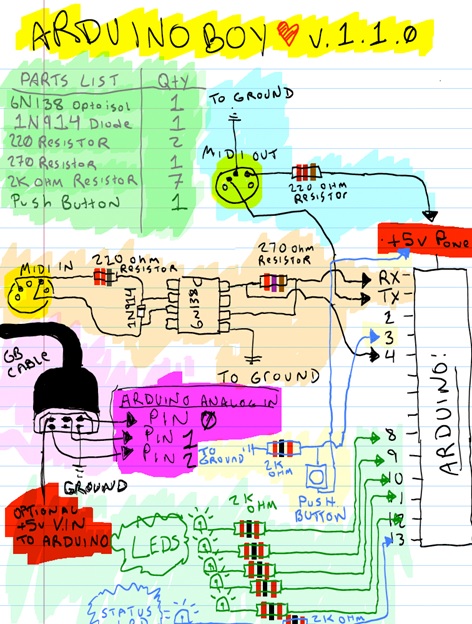
Figure 2. Schematic of how to build an Arduinoboy, via https://github.com/trash80/arduinoboy.
[4.6] The Game Boy's journey from toy to tool encapsulates the shift from remediation (simulating prior media through Nintendo-produced software such as Trippy-H for the Game Boy Camera) to enmediation (redefining the core purpose and access of the console itself, beyond Nintendo's corporate control). In repurposing the Game Boy for live performance, these fan-developed tools complete a transition from passive gameplay to performative authorship, demonstrating how new creative modes can be catalyzed within enmediated ecologies.
5. Sounds, platforms, and creative activity
[5.1] The creative repurposing of the Game Boy through music-generation tools like Shitwave (note 1) exemplifies how enmediation operates not only at the level of hardware or production but also in live performance aesthetics. Developed by chiptune artist nitro2k01, Shitwave transforms the Game Boy into a drone generator, using pseudo-randomness to create soundscapes and accompanying visuals (nitro2k01 2009). This dual functionality reflects a multimodal enmediation. The Game Boy is not simply played; it performs.
[5.2] In the context of live performances of chiptune in front of an audience, Stark's observation that visibility of performance enhances audience engagement (Stark 2011) finds direct application. Shitwave's real-time waveform visuals make the sonic act tangible, creating an immersive spectacle akin to gameplay itself (McMahan 2003). The Game Boy, originally a single-user entertainment device, becomes a focal point for collective experience, an inversion of its intended function.
[5.3] Beyond generating sound internally, the Game Boy has also been used as a control interface for external software. Projects like Faderfox Jr, a software recreation of a popular hardware MIDI controller, extend the enmediated potential of the Game Boy even further, demonstrating that its form can mediate not just its own sound, but broader digital musical ecologies. This reflects Berry's assertion that enmediation involves securing new boundaries and functionalities for a medium within entirely different contexts. Figure 3 shows the Game Boy program, consisting of a screen of virtual controls mimicking the physical Micromodul LX1 MIDI controller.
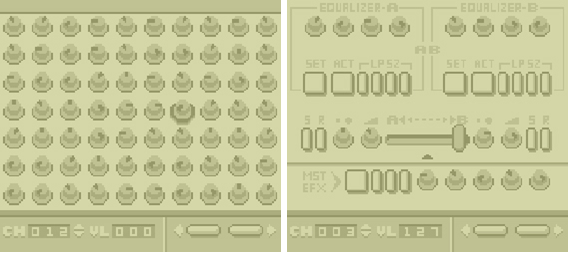
Figure 3. Faderfox Jr interface (from 8cylinder 2024).
[5.4] By using the Game Boy as a controller rather than a sound source, these tools separate form from function. The Game Boy's physical affordances (its buttons, screen, and portability) are repurposed for applications far removed from gaming. In this way, the device is stripped of its original purpose and reinscribed with new meaning, marking a clear shift from remediation to full enmediation.
[5.5] This is not simply a matter of nostalgia or retro appeal; rather, it reflects a genuine reassessment of user interfaces and control schemes. The Game Boy becomes a bridge between intuitive, tactile design and contemporary music software, offering accessibility alongside an idiosyncratic aesthetic. Its persistent cultural presence speaks to its symbolic and practical resonance in creative circles.
[5.6] These developments underscore how fan practices need not merely be about reusing old media, but also about recontextualizing and reconfiguring them. The Game Boy is no longer a passive object of retro interest but an active node in a transmedia creative ecology. Its role in live performance, sound design, and interface experimentation marks a radical reimagining of its place within digital culture, enabled entirely by the enmediating practices of its fan base.
6. Game Boy creative communities
[6.1] Enmediation, as conceptualized by Berry (2013), is not only about the technical reformatting of a platform; it also requires the construction of new media ecologies around it, both social and cultural. In the case of the Game Boy, fan-driven communities have played a pivotal role in developing, sustaining, and extending its creative potential. These communities operate as the sociocultural infrastructure of enmediation, continually negotiating and expanding the platform's meaning and function.
[6.2] Brian Eno's concept of "scenius" (quoted in radiocitizen 2009) discusses the collective intelligence of creative communities and offers a useful lens for understanding these ecosystems. Rather than emphasizing the lone innovator, Eno encourages us to focus on the distributed nature of innovation. In this sense, Game Boy fan communities exemplify scenius: No single individual transformed the console into a musical instrument or development platform; rather, it was the product of collective exploration, support, and iteration.
[6.3] Through enmediation, the Game Boy became a platform for cultural participation. With the lifting of Nintendo's creative constraints, fans were free to collaboratively uncover and extend the device's latent affordances. Every new discovery (whether a programming hack, audio mod, or visual style) was not just a technical feat but a cultural contribution to a shared, open-ended project of reinterpretation.
[6.4] In this distributed media ecology, expertise was, and remains, networked. Technical know-how and creative vision circulated through forums, netlabels, and live events. Artists who lacked programming skills could still collaborate with developers and developers could be inspired by musicians' ideas. Enmediation, therefore, fostered a creative interdependence where no one actor held absolute control, and innovation emerged from the collective mesh.
[6.5] This model of fandom (fluid, collaborative, and infrastructure-building) contrasts with more passive consumer-driven modes. Yet its sustainability has often hinged on the platforms that host it. Forums like 8bc.org, subreddits, and Discord servers were not just gathering points but enabling architectures. They were the arenas where enmediation took root, documentation was shared, norms were negotiated, and tools were refined.
[6.6] However, these communities also illustrate the fragility of digital infrastructure. As Sibai et al. (2024) point out, even the most vibrant online spaces can turn hostile or collapse when power is centralized or when governance mechanisms fail. The Game Boy scene has witnessed such collapses, with projects like 8bc.org and ChipWIN folding because of personal conflicts or burnout—reminders that enmediation is not a stable endpoint but a continuous, precarious process.
[6.7] The closure of 8bc.org in 2011 was particularly disruptive. As a hub for chiptune shows, software, and community news, it functioned as a key node in the Game Boy's enmediated ecology. Its sudden disappearance fragmented the community, leading to a diaspora across less centralized or more corporate platforms, such as Facebook, Reddit, and eventually Discord.
[6.8] The migration to Discord following the closure of ChipWIN in 2020 introduced a new phase of enmediation. Here, the focus shifted to smaller, more focused groups with explicit commitments to transparency and distributed leadership. These communities, like "A Bit of Chiptune," aimed to learn from the mistakes of their predecessors, embedding governance into the structure of their digital space.
[6.9] Each migration brought new affordances and limitations. While bespoke platforms offered tight-knit communities and detailed archives, corporate platforms often lacked longevity, transparency, and searchability. As Fiesler and Dym (2020, 42:16) note, switching platforms incurs high coordination costs, especially in fan communities built around informal relationships and shared knowledge. For example, Discord's strengths in real-time collaboration come with trade-offs. As Tuck et al. (2023) observe, closed platforms hinder discoverability and knowledge retention. Conversations that once played out in public forums (searchable and archivable) now occur in siloed channels, reducing visibility for newcomers and casual observers. This architectural shift subtly reshapes the ecology of the community and alters the nature of its inclusivity; enmediation occurs and is discussed on scattered, distributed ecosystems.
[6.10] As tools like GB Studio gained traction post-2019, particularly during the social isolation of the COVID-19 pandemic, creative communities continued to evolve. The boom in development activity during this period is not just attributable to increased free time but also to the maturing of the Game Boy's enmediated infrastructure. Documentation platforms (https://gbdev.io/) bridged the gap between technical depth and creative accessibility, although these, too, are often disconnected from the distribution platforms (like itch.io) where end users encounter finished games.
[6.11] What emerges, then, is an ecology in which production, discussion, and distribution are increasingly disaggregated. While this fragmentation poses challenges, it also speaks to the platform's resilience. The Game Boy, as an enmediated object, persists through the creative determination of its communities even as those communities navigate evolving, and sometimes unstable, digital terrain.
7. Building artist communities through comps, game jams, and live gigs
[7.1] As suggested above, an enmediated Game Boy allows collaboration in ways that its mass-market form did not, the demediation brought about at the end of its commercial life allowing new possibilities to emerge and creative communities to coalesce around the platform. Its enmediation is, as we have already noted, not only technical and cultural; it is also social. Creative practices like compilation albums (comps), game jams, and live performances act as communal rituals within this new media ecology. They provide the infrastructure for discovery, collaboration, and legitimation, allowing fans to collectively build and maintain a shared creative culture around the enmediated platform.
[7.2] As well as according with Eno's scenius, these practices align with Lévy's notion of collective intelligence (1997), where the knowledge of a group exceeds the capabilities of any single individual. In Game Boy communities, comps and jams serve precisely this purpose; they pool distributed talent, lower the barrier to entry, and foster a supportive environment where newcomers and veterans alike can share, learn, and evolve.
[7.3] Netlabels, such as CatchyNameRecords and Kittenrock, which issued open calls for chiptune compilations in the early 2000s, exemplify how decentralized publishing can become a mode of enmediation. By bypassing traditional music industry gatekeepers, these labels enabled fan musicians to distribute work created on a platform long thought obsolete. The platform itself, through these collective outputs, was symbolically and practically reborn as a node of ongoing cultural relevance.
[7.4] This model of accessible collaboration continued into the 2010s through projects like Chiptunes=WIN, which expanded the scope and scale of compilation albums. The fact that later comps were released not just digitally but as physical Game Boy cartridges underscores the recursive nature of enmediation. Fans not only transformed the platform but began producing new media objects for it, extending its ecology in both directions: forward into digital platforms like Bandcamp and backward into the console's hardware affordances.
[7.5] Similarly, game jams offer an iterative, experimental space where developers work within constraints to produce small-scale projects. For Game Boy developers, jams provide a double-layered challenge: one set by the event's theme, and another imposed by the console's original limitations. This combination reaffirms Stokes's (2001) concept of constrained creativity, where artistic expression is sharpened rather than hindered by restrictions.
[7.6] GB Studio–specific jams hosted on itch.io demonstrate this dynamic well. The drag-and-drop nature of GB Studio makes it accessible to nonprogrammers, while the jam format encourages creative risk-taking without the pressure of commercial expectations. In this way, jams perform an important social function in enmediated ecologies; they transform casual users into producers and provide scaffolding for ongoing participation.
[7.7] Pixel art competitions hosted by the GB Studio community further blur the lines between artistic production and fan practice. These events reflect the shift from passive appreciation to active contribution, a hallmark of enmediated fandom. Importantly, they are designed to be nonhierarchical (entries are often showcased without formal rankings) reinforcing a communal rather than competitive ethos.
[7.8] Live gigs have long been a defining aspect of the chiptune scene, with the portability and simplicity of Game Boy hardware making it an ideal tool for DIY performance. Events like the Blip Festival, as memorialized in the documentary Reformat the Planet (2008), demonstrate how enmediation manifests not just in software or aesthetics but in embodied, collective experiences. These performances reclaim public space for fan creativity and cement the Game Boy's place as a legitimate musical instrument.
[7.9] Practicality has played a crucial role here. The ability to sync two Game Boys using a link cable and run them through a small mixer represents a functional, grassroots alternative to more elaborate and expensive setups. Such hardware-level simplicity mirrors the software-level accessibility of tools like LSDJ and Nanoloop, creating a coherent ecology of low-cost, high-expression creative production.
[7.10] The collaborative events built around the Game Boy represent an ecosystem of shared practice and mutual support. These gatherings (whether online or offline) anchor the enmediated life of the platform. They offer both the creative infrastructure and the social rituals necessary to sustain a fan-driven media ecology long after the manufacturer has exited the scene.
8. New fan production in Game Boy gaming
[8.1] The enmediation of the Game Boy has not been limited to music. Over the past decade, game creation itself has become a central fan practice on the platform. Although game engines emerged over a decade later than similar tools for musicians, the relatively late rise of accessible game development frameworks reflects different temporal and technical trajectories, albeit with similar implications for creative empowerment and platform redefinition.
[8.2] Retro gaming's resurgence reflects more than nostalgia. As Suominen (2008) argues, and Lima and Varga (2023) demonstrate through practitioner interviews, it reveals a historically constructed and socially performed form of media memory. It situates platforms like the Game Boy as not merely relics of the past but as canvases for present-day cultural expression. In this sense, the development of new Game Boy games through GB Studio is not retrograde; it is forward-facing reinterpretation through enmediation.
[8.3] GB Studio (https://www.gbstudio.dev/) exemplifies how enmediation can be operationalized. As a free, open-source, and cross-platform game engine, its drag-and-drop programming interface radically lowers the technical threshold required to create playable games for the Game Boy. This democratization of development echoes the ethos of earlier maker cultures while expanding the Game Boy's fan ecology to include artists, writers, and designers with little or no programming background.
[8.4] The COVID-19 pandemic served as a catalyst for this shift. Social isolation, paired with the growing accessibility of creative tools, contributed to a wave of GB Studio adoption. The appeal was both practical and affective. The Game Boy's simple resolution, nostalgic palette, and constrained design is seen to have offered a comforting return to tactile aesthetics and a manageable scope for creative projects during a time of widespread uncertainty (Marston 2021).
[8.5] One of the most striking genre trends to emerge from this enmediated wave of fan development has been the rise of horror games; this is particularly noteworthy given how poorly this genre was supported during the console's commercial life. Nintendo's gatekeeping practices and content moderation norms for the Game Boy series made titles such as 2001's Resident Evil Gaiden for the Game Boy Color (Aniel 2022) outliers. In contrast, fan-created horror games such as Opossum Country (BenJelter 2021), Neighbor (Horatiu.nyc 2020), and Cryohazard (Burst-error 2022) are amongst the most popular games to have been made with GB Studio (https://itch.io/games/made-with-gb-studio).
[8.6] These titles not only repurpose the Game Boy's hardware for new narrative experiences but also symbolically challenge the content boundaries once enforced by Nintendo. Enmediation here involves not just technical transformation but cultural redefinition: Fans expand the expressive palette of the platform by introducing themes, aesthetics, and mechanics that would have been commercially unviable in the past.
[8.7] Importantly, these games are not limited to digital distribution. With the release of Deadeus (Trew 2021), a horror title published as a physical Game Boy cartridge, the boundary between past and present was further collapsed, and led to new physical releases being made commercially available, such as 2024's Life's Too Short and From Below (Banks 2024). This physical instantiation of new fan content reinforces the full enmediation of the platform; it is not just emulated or invoked but materially reinhabited.
[8.8] That these games are created using GB Studio yet distributed in forms identical to 1990s Game Boy cartridges underscores a dual allegiance: to the affordances of modern software and to the material legacies of the platform's past. This double movement between nostalgia and innovation is a hallmark of enmediated fan practice.
[8.9] Horror's disproportionate popularity in fan-produced Game Boy games is especially revealing. Where commercial developers once avoided risk (perhaps due to commercial necessity or conservatism), fans are able to embrace it. Through enmediation, the Game Boy becomes a vessel for exploring themes it was never meant to contain, testifying to the power of fan-led production to reimagine not only the platform but the cultural logics surrounding it.
9. Conclusion
[9.1] We have applied a novel framework of demediation and enmediation to theorize fan production on proprietary gaming platforms. For the Game Boy, and in similar contexts, we see demediation as a ceding of control by the owners of the platform (in this case, Nintendo), and enmediation as a process where fans build tools and frameworks to enable grassroots creativity. Beyond the ocular (Berry 2013, 33), enmediation has redefined the material and cultural identity of the Game Boy. By repurposing the platform through grassroots tools, musical experimentation, and game development, fans have transformed the Game Boy from a proprietary product into a dynamic node within participatory media ecologies.
[9.2] Unlike remediation, which emphasizes the reformatting of older media within newer ones, enmediation attends to the reconstitution of platforms within altered systems of power and creativity. In the case of the Game Boy, this means understanding how its uses and meanings have shifted through practices no longer governed by Nintendo's original licensing and development regimes.
[9.3] The Game Boy Camera provides a useful point of contrast. While its expanded use illustrates fan ingenuity, it largely remained within the functional and cultural limits laid down by Nintendo. Thus, its trajectory can be seen as an extension of commercial intent. In contrast, chiptune production, homebrew games, and controller modifications represent true enmediation: not just the enhancement of a platform but its transformation into something fundamentally new. In short, an extension of capabilities is not necessarily an indicator of enmediation.
[9.4] As we have shown, the Game Boy's enmediation is ongoing. Whether through the evolution of tools like GB Studio, the shifting nature of online community platforms, or the production of physical cartridges containing new work, the platform continues to be shaped and reshaped by its users. Each iteration reaffirms the role of fan labor—not as derivative but as generative, capable of extending and redefining the media landscape.
[9.5] The broader implications of this study reach beyond the Game Boy itself. Many proprietary platforms that have been demediated, whether obsolete computers, abandoned consoles, or early web services, are similarly being enmediated by users who imagine new creative futures for them. The Game Boy, in this regard, serves as a compelling model for how grassroots engagement, technical ingenuity, and cultural memory can intersect to revitalize obsolete media.
[9.6] We suggest that another contribution of this work is to see fan communities as the collective scaffolding for enmediation. In cases such as the Game Boy, these communities do not simply consume media forms; they build infrastructure, share knowledge, develop tools, and organize collaborative events. The Game Boy's demediation (its exit from the corporate realm) was the necessary precondition for this enmediated rebirth.
[9.7] This study is also relevant to media-archaeological discussions of seemingly obsolete platforms. Far from using obsolescence as a cover for nostalgia (as critiqued by Elsaesser 2015), we suggest that so-called dead media can be revivified through the practices that result from, and which surround, enmediation. This approach allows us to foreground issues of ownership and agency.
[9.8] Ultimately, the Game Boy's postcommercial life exemplifies how media artifacts can be reinhabited and reinterpreted in ways that challenge linear narratives of technological obsolescence. Through enmediation, a once-closed platform has become a site of open creativity, reminding us that what media are depends less on their original design, and more on what communities imagine they can become.
10. Acknowledgment
[10.1] We are grateful to Professor Leighton Evans, Swansea University, for his valuable comments on an early version of this manuscript. Any errors and misinterpretations remain our responsibility.