1. Introduction
[1.1] The term homebrew never appears in the official ruleset trilogy for Dungeons & Dragons 5th Edition (5E) nor any previous editions of the game. Yet, homebrewing is inseparable from the culture and practice of tabletop role-playing games (TTRPGs). It is difficult to imagine any contemporary TTRPG session without some element of homebrew. Dungeon Masters (DMs) can homebrew spells, subclasses, and campaign settings, or be laxer about rules-as-written. While never officially named as such, Dungeons & Dragons, hereafter D&D, has a long-running and thriving homebrew culture with Advanced Dungeons & Dragons (1977) encouraging players to "Add, create, expand, and extrapolate" from the core rule set while chapter 9 of the 5E Dungeon Master's Guide (2014) outlines a variety of customization options that have informed many DMs' optional rules, that is, homebrews (note 1). One might even argue that D&D is itself a homebrew given its origin as a variation of Chainmail (1971). Further, throughout D&D's history, many former homebrews—such as Ed Greenwood's "Forgotten Realms" setting—have been incorporated into official D&D, revealing the slippery distinction between homebrew and official content.
[1.2] Homebrewing has been given added TTRPG cultural legitimacy in recent years with the rise of popular Actual Plays (APs) like Critical Role and Dimension 20 with Matt Mercer's "Blood Domain Cleric" subclass, Brennan Lee Mulligan's "rolling with emphasis," and The Adventure Zone's "Flaming Poisoning Raging Sword of Doom" serving as famous homebrews that have inspired many home game DM's to incorporate more ambitious, and often unbalanced, homebrew into their home games. TTRPGs are in the age of homebrew as evidenced by the massive repository of homebrew elements listed on DnDBeyond where there are, for example, 208,560 homebrew monsters and 516,100 homebrew magic items. Further, initially homebrewed systems like Pathfinder (2009) have become popular TTRPG systems in their own right, and some homebrews like "critical skill checks" are so pervasive that many believe these are official rules. Homebrewing and other forms of player-driven modification are thus central to contemporary TTRPG culture.
[1.3] Homebrewing is also a central fan practice that offers insight into the value systems embedded within the TTRPG community. Drawing on recent work in game studies that recognizes how gaming culture reflects and reproduces larger social strictures, I am interested in how TTRPG homebrewing inherits, reproduces, and challenges the cultural legacies in suburban hobby gaming culture. Aaron Trammell persuasively argues that contemporary gaming culture is enmeshed in the broader history of "white geek masculinity" that emerged because of suburban white flight, and he reveals how early TTRPG culture privileged a white suburban male player base at the exclusion of various marginalized groups (2023, 15). Likewise, Benjamin Woo points out that "the image chosen to represent geeks and nerds in the media is almost invariably a straight white man" despite the long presence of women and people of color in nerd communities (2018, 10). These legacies continue to inform contemporary TTRPG gaming practices. For instance, Shelly Jones and Tanya Pobuda (2020) document online backlash against "pronouns and gender inclusion in board game rulebooks," and their research reveals analog gaming culture remains profoundly informed by masculinist ideology even as the industry diversifies. Steven Dashiell argues that the symbolic linguistic capital of the rules lawyer reifies "the sense of expressive geekdom being White and male" (2017). TTRPG homebrewing can both inherit and challenge the racial, gendered, and classed legacy of hobby gaming culture. Jones and Pobuda (2020) describe an outraged board gamer changing inclusive pronouns in gaming rulebooks "to include only 'he' in reference to a player," which they point out is a homebrewing practice rooted in reactionary conservatism. However, homebrewing can also function as a subversive practice that offers players the power to emerge as fan-creators in TTRPG play while challenging hegemonic norms built into the medium. Through these transgressive homebrewing practices, player-creators critique and reimagine the hegemonic values embedded in systems like D&D by introducing new mechanics and narrative focuses that explore liberatory possibilities.
[1.4] I situate homebrewing as a dual act of fan-led creative participation and ideological negotiation around the racial, class, and gender assumptions embedded within gaming communities through a case study of homebrewing in D&D 5E (note 2). I begin by tracing the historical lineage of TTRPG homebrewing to earlier hobbyist practices, particularly the Homebrew Computer Club, to reveal its sociohistorical foundations that privilege suburban white male upper-middle-class subjectivity. I then offer a brief overview of the history of D&D homebrewing before using data scraping to examine homebrewing in Dungeon and Dragon magazines as well as in D&D-focused subreddits. Based on this research, I develop a taxonomy of contemporary homebrew practices and examine the varied receptions these practices elicit, ranging from purist backlash against homebrew to praise for the ability of homebrew to challenge problematic value sets in the D&D rules. Finally, I turn to fan reception of Aabria Iyengar's work as a DM in four seasons of Dimension 20 as a case study to highlight the expectations around homebrewing in AP fandom, which I argue can offer potential insights into views around homebrewing in the larger TTRPG culture.
2. Defining homebrew
[2.1] According to the OED, the word homebrew was first used in 1771 to describe the brewing of alcoholic beverages at home for personal consumption. While it is now taken as a given that the fan practice of TTRPG homebrewing is based on homebrewing alcohol, I propose a second parallel lineage: the hobby culture epitomized by the Homebrew Computer Club. By the mid-twentieth century, "homebrew" found a new usage in hobbyist culture to refer to homemade material "designed by a user as an alternative or adjunct to a proprietary product." The term gained cultural purchase among electronic hobbyists who began using it to refer to the self-creation of ham radios, personal computers, and video games. The Homebrew Computer Club, founded in 1975 in Menlo Park, California, represents the most iconic example of this tradition. The group bonded over a shared love of building microcomputers, and this now-legendary group of hobbyists laid the foundation for Silicon Valley as members like Steve Wozniak, Steve Jobs, Bill Gates, George Morrow, and Adam Osborne would all go on to contribute to the early personal computer industry. In her authoritative article about the Homebrew Computer Club's newsletter, Elizabeth Petrick found that "four rough themes emerged about the technology they built: their personal desires as users, practical concerns as hobbyists, influences and dynamics of this specific hobbyist community, and community values rooted largely in the counterculture and hackers" (2017, 28). In other words, the Homebrew Computer Club conceptualized themselves as a counterculture community of like-minded individuals who were participating in a shared hobby, and their communal participation—the extensive shared technical guidelines on building homebrew materials—curated a sense of collective authorship over their hobby.
[2.2] These cultural dynamics of the Homebrew Computer Club mirror the collective practices of TTRPG culture. Excepting some solo-TTRPGs such as Tim Hutchings's Thousand Year Old Vampire, TTRPG play is an act of collective authorship where "the enacted performance of TRPG play at the table is a kind of tertiary authorship that emerges in conjunction with the secondary authorship of the game master (GM) as story-builder or scenario writer who mediates the primary authorship of the game designer as worldbuilder and rules-maker" (White et. al. 2018, 64). Homebrewing—from players or the GM—further blurs the lines of authorship in TTRPG playing and home performance. Indeed, we can easily adapt the four themes that Petrick describes emerging from the Homebrew Computer Club newsletter to fit the motivations of many TTRPG tables: personal desires as players, practical concerns as gamers, the influences and dynamics relevant to the TTRPG hobbyist community, and community values rooted largely in the counterculture of geek hobby gaming. Intentional or not, the cultural values of the Homebrew Computer Club inform the collective authorship of contemporary TTRPG culture. There is, however, another inheritance that TTRPG homebrewing claims from the Homebrew Computer Club: the white geek masculinity embedded within the origins of both the Homebrew Computer Club and TTRPGs.
[2.3] In The Apple II Age, Laine Nooney notes that the Homebrew Computer Club's existence was predicated on "a set of mutually overlapping conditions surrounding work, leisure, gender, race, and class within the hobbyist communities that would first take an interest in computer ownership," and she argues that "participation in the hobbyist community hinged on certain socioeconomic advantages that intersected strongly with race and gender" (2023, 30, 31). While the Homebrew Computer Club was not exclusively white nor male as video game pioneer Jerry Lawson and educational technology innovator Liza Loop were members, the Homebrew Computer Club membership was predominantly white upper-middle-class suburban men. These dynamics are simultaneously engrained in the history of hobby gaming and TTRPGs. In The Privilege of Play, Aaron Trammell tells the story of white masculinity among geeks through the history of hobby gaming culture, and he argues that "the [TTRPG] community's suburban mindset was a holdover from segregationist policy and white flight" (2023, 80). For Trammell, "Hegemonic masculinity and white privilege overlap in the history of hobby games and yield a set of seemingly paradoxical values" where "geeks see themselves as outsiders because they have been empowered by white privilege yet feel excluded from the domain of hegemonic masculinity to which they feel entitled" (5). Likewise, in his dissertation "Geek Cultures: Media and Identity in the Digital Age," Jason Tocci points out that the labels of "geek" or "nerd" are "often first applied to many in the context of social exclusion," yet "geeky communities can" become "inhospitable to those who don't fit the stereotypical mold," particularly people of color, women, and LGBTQ+ individuals (2009, 137). The Homebrew Computer Club operated under similar identitarian slides: their then-niche and geeky hobby of microcomputer use signaled their nonconformity, yet their collective suburban white masculine subjectivity provided them with the material access and community to pursue their homebrewing hobby.
[2.4] The early TTRPG community and the Homebrew Computer Club are quite literally cut from the same cloth, and both are informed by white geek masculinity. TTRPG homebrewing inherits not only the collective and creative ethos of the Homebrew Computer Club but also its embedded structures of privilege while shaping the possibilities and limits of fan creation. The following section provides a brief history of homebrewing practices in D&D before turning to a taxonomy of contemporary homebrewing practices.
3. A brief history of homebrewing in D&D
[3.1] The practice of homebrewing has long coexisted and stood in tension with the corporate side of TTRPG culture, which is to say whichever company owns D&D at the given moment. Since its inception, D&D has encouraged player creativity, but the interplay between fan-driven innovation and corporate control has been complex, particularly around questions of authorship and IP. Despite numerous policies restricting the sharing of homebrewing, D&D players have persisted in their fan creation practices. The history of homebrewing in D&D, then, is a history of tension, shifting corporate policies, and counterpractices among the D&D fandom.
[3.2] Before exploring this history, it must be noted that the line between homebrew and official content is fluid. Maria K. Alberto's insightful research on canon formation in D&D demonstrates how contested the notion of canonical content is within D&D's fandom and WotC's business practices (2024). This ambiguity is further illustrated by a popular Reddit comment on DnDNext that outlines the "sliding scale of how official or not official things are" in the D&D universe by categorizing D&D content into six tiers of canonicity: Core Rules, Supplemental Publications, Alternative Setting Guides, Charity Publications, Unearthed Arcana, and Homebrew. I define homebrew as any materials not published by Tactical Studies Rules (TSR) or Wizards of the Coast (WotC). Under this definition, some homebrews eventually become official while others—such as Mercer's Blood Hunter subclass—should be considered professional homebrew. I primarily focus on nonprofessional homebrews, though I do include mentions of professional homebrews. While beyond the scope of this discussion, further research is needed on the blurred distinction between amateur homebrew, professional homebrew, and canon.
[3.3] Homebrewing has been present since the inception of D&D. The game was initially published by TSR, and the company encouraged players to create and share their homebrew rules and settings in the early years of D&D, which cultivated a robust set of community-created homebrew materials published in magazines and early internet forums throughout the 1980s and 1990s (note 3). However, TSR's openness to published homebrew shifted over time, and by the early 1990s when TTRPGs saw a decline in popularity, TSR adopted an actively litigious approach to regulate fan creation. For instance, in 1994, TRS implemented a restrictive web policy that led to incidents like the shutdown of a popular D&D file-sharing website at Stanford University. These events earned TRS the derisive nickname "They Sue Regularly" among TTRPG fans (Hartlage 2020), and TSR's litigious actions created a "chilling effect" that discouraged online sharing of homebrew materials (Maliszewski 2009). For this reason, it remains difficult to find evidence of the vibrant online homebrewing culture during the early days of the internet. However, physical media like published homebrew modules or TTRPG magazines reveals that homebrewing continued to be a popular practice throughout the late 1990s.
[3.4] The acquisition of the D&D IP by WotC was a major turning point in the game's official relationship with homebrew. TSR sold D&D to WotC in 1997, which was in turn purchased by Hasbro in September 1999. WotC and Hasbro launched D&D third edition in 2000 and introduced the Open Gaming License (OGL) and the System Reference Document (SRD). These documents enabled "the creation of legal support products for" D&D (Maliszewski 2009) and revitalized the homebrew community as homebrew materials became increasingly easier to publish both online and in physical media. Game systems like Necromancer Games' The Wizard's Amulet (2000), Troll Lord Games' Castles and Crusades (2004), Daniel Proctor's Labyrinth Lord (2007), and Stuart Marshall and Matt Finch's OSRIC (2008) are all popular TTRPGs that were published using the OGL, and the development of these systems reflects the increasing professionalization of homebrew—something only possible because of the OGL.
[3.5] D&D's recent meteoric rise in popularity has reignited the tensions between homebrewers and the game's corporate stakeholders. A flashpoint occurred in 2023 when WotC proposed controversial revisions to the OGL that included a requirement for creators to pay 25 percent of their profits to WotC and granted WotC the right to republish any previously published OGL materials without crediting or paying the original creator. The backlash was swift and fierce, and WotC abandoned these proposed changes. This incident underscores the ongoing friction between the homebrewing fan communities and the corporate interests of D&D. Indeed, it is notable that many homebrew systems emerged as a response to player dissatisfaction with official D&D products. For example, according to Rebecca Bryant, D&D fourth edition "spawned a negative response so strong that players" began altering "the game system against the wishes of its owners," and she rightfully contextualized the rise of open-license systems like Pathfinder as part of a fan-centered rebellion against WotC (2009). Paul Mason, however, points out that these practices of fan ownership have been embedded in TTRPG culture since the earliest days of the medium, which he attributes to the "vagueness" of most early TTRPG rulesets (2012). Steve Darlington likewise argues that AD&D's "impenetrable rules forced players to invent their own rules and […] to begin thinking about rules systems and their design" and suggests that "D&D is perhaps the first game that players purchased with the knowledge that at least half of the rules would have to be discarded or seriously altered" (quoted in Mason 2012). Homebrewing has been part of D&D since its inception and homebrew's continuous uneasy relationship with official D&D.
[3.6] Exploring the usage of the term in physical media and online communities, it becomes apparent that homebrewing has evolved from an informal practice to an integral part of D&D's identity. For instance, the game's official magazines, fittingly named Dragon (1976–2012) and Dungeon (1986–2013), provide us with some insight into the use of the word in the TTRPG fan lexicon (note 4). In total, the word "homebrew" is mentioned fifty-three times across 430 Dragon issues and 221 Dungeon issues, with the earliest mention coming in issue 39 of Dragon published July 1980 (note 5). While six of these mentions refer to homebrewing alcoholic beverages and two refer to homebrewing computers, the remaining mentions offer important insights into the practice of homebrewing in early D&D play:
- [3.7] Fan mail titled "Flame the Turtle": "I really do love this magazine. It is the blood and soul of my D&D campaigns, and I'm simply too busy to run homebrew anymore" (Dungeon #98 2003, 7).
- Fan mail titled "Old School Gamer": "However, as a GM, I suspect I'm atypical. My campaign uses a homebrew system. The campaign is low-powered compared to Forgotten REALMS or EBERRON, A truly legendary character in my world would only rate about 9th level using the core D&D rules. So you see, I can't use Dungeon's high-level adventures without a lot of work" (Dungeon#122 2005, 14).
- In a negative review of the "Lost Hunt" module, the reviewer critiques the rigidness of the module for not allowing for the incorporation of homebrew elements (Dragon Annual 6 2001, 82).
- Erik Mona's letter from the editor: "Since most of our readers favor 'homebrew' campaign settings over official worlds like the Forgotten Realms, Greyhawk, and Eberron, Dragon would henceforth avoid articles with strong ties to those campaigns" (Dragon #328 2005, 8).
- Article titled "The Perfect Pantheon: Brewing Up The Right Gods": "Dungeon masters use homebrew campaigns for lots of reasons: more control over the NPC roster, no chance that some setting lawyer will harass you about details in a sourcebook you haven't read, and a chance to set everything up the way you've always imagined it" (Dungeon #146 2007, 88).
- Column about D&D: A DM discusses the strategies that he needed to adopt to make his game work using a homebrew 3E setting with 4E rules, and the DM says it required "renaming, selective retroactive continuity, and a significant time shift" (Dungeon #171 2009, 114).
- Chris Young's letter from the editor: The magazine asks players to write in their homebrew methods to the magazine (Dungeon #177 2010, 3).
[3.8] These different usages reveal the pervasiveness of homebrewing in D&D culture and the flexibility of the concept. Additional terms like "reflavor" (twenty-three mentions in Dragon), "hack" (235 mentions in Dragon and sixty-three in Dungeon), "kitbash" (six mentions in Dragon), "house rule" (five mentions in Dungeon and 170 in Dragon), and "reskin" (three mentions in Dragon and five in Dungeon) are commonly used in both magazines. The popularity of these terms suggests that the practice of homebrewing, even when not named as such, has long been present in D&D's history (note 6).
[3.9] Some of the exchanges in the magazines reveal the fraught nature of homebrewing. For instance, there is an extended debate across several issues of Dragon over the superiority of homebrew versus pregenerated modules. In Dragon #166, Craig Hardie wrote a fan mail response lamenting the increase in articles about pregenerated game worlds and argued that "the prime purpose of being a Dungeon Master was to gain a sense of accomplishment by designing what is (for the GM and his players) the 'perfect' fantasy world" (1991). This letter sparked numerous responses in subsequent issues where respondents stated they were "perturbed" by the letter, "agree completely," "don't believe most DMs have time to create a whole world by themselves," and "can say no less than 'Bravo!'" In Dragon #185, Jeff House offered a nuanced response that aptly encapsulates the larger debate: "I find it difficult to believe that your readers, or at least the ones who responded to Craig's letter, are so ardent in their beliefs of the superiority of completely home-brewed campaign worlds over packaged ones. […] The truth of the matter is that strict adherence to either is bad. In gaming, as in life, moderation and compromise are the keys" (1992).
[3.10] The divergent responses to Craig's letter underscore the contentious position that homebrewing has long had in D&D culture. This conversation also exposes some of the positionality assumptions embedded within early D&D homebrewing. For instance, all the correspondents' names are gendered male, which reifies homebrewing as the domain of male TTRPG fans. While the correspondents' race and sexuality are impossible to identify from the letters, subtle references to class emerge, particularly in the discussion about having the free time and resources necessary for extensive homebrewing. These exchanges highlight the unstated affordances that shape homebrewing's cultural identity and bolster homebrewing's association with the white geek masculinity that defines other hobbyist spaces like the Homebrew Computer Club.
[3.11] Finally, the rise of online D&D discussion boards further cemented homebrewing as a cornerstone of D&D culture. The word has been in popular usage online since at least 2003 when the Wizards Community Boards hosted a discussion forum about Dragonlance and user kexizzoc87 posted, "As someone who has not until recently learned much about Dragonlance, I'm excited to see what it can offer my homebrew campaign" (https://dungeonsdragons.fandom.com/wiki/Homebrew). By August 2003, the Wizards Community Boards included a forum for homebrew campaign settings. In 2005, WotC used homebrew to refer to fan-made settings in online articles. The DnD wiki created a fan-made digital repository in November 2007 to collect all different types of homebrewing, and since 2017, WotC has included a homebrew section on DnDBeyond. Homebrewing remains a vital, if often contested, part of D&D's identity while also reflecting some of the positionality assumptions embedded within the hobby.
4. Homebrewing on subreddits
[4.1] The rise of social media has further expanded the reach and visibility of homebrewing practices within the D&D community. Among these platforms, Reddit has become a significant hub for discussing, sharing, and critiquing homebrew content, and an overview of popular D&D-focused subreddits offers key insights into contemporary homebrewing practices. To explore these practices, I employed a mixed-methods approach combining quantitative and qualitative analysis. Using a Python script, I scraped the top one thousand posts and associated comments from four popular D&D-focused subreddits: r/DnD, r/DnDNext, r/DMAcademy, and r/DnDHomebrew. At the time of writing, the subreddits have 4 million, 787,000, 649,000, and 230,000 users, respectively. Subreddits function as "discourse communities" with "broadly agreed set of common public goals and functioning mechanisms of intercommunication among their members" (van Nuenen 2021); subreddits offer important insights into a community's values. The resulting data was organized into eight CSV files, one for the posts and one for the comments of each subreddit. Each CSV file was placed into Voyant where I used the software to determine the frequency of the word "homebrew" across the corpus and locate the words that were collocates (words found in proximity to mentions of homebrew) and correlations (words found with higher relative frequency to homebrew compared to the rest of the corpus) (note 7). I supplemented this quantitative research with qualitative readings of select posts that discuss homebrewing across the subreddits as well as select YouTube videos and discussion forums where D&D homebrewing is mentioned.
[4.2] Before delving into the research, it is necessary to discuss the ethical considerations of scraping Reddit comments and posts. This study uses publicly available Reddit posts, scraped via a Python script, as a key data source. While Reddit is an open-access platform, the ethical status of using such data in academic research remains unsettled. The visibility of user-generated content online does not automatically equate to consent for its reuse in academic research (Adams 2024; Luscombe et al. 2021). Users may not expect their posts to be analyzed, archived, and published in scholarly contexts, and scholars should consider three key ethical considerations when using Reddit data for scholarly research: "replication, consent, and identification" (Adams 2024, 55). In line with best practices outlined by Megan A. Brown et al. (2024) and the Association of Internet Researchers (franzke et al. 2022), I approach this data with an ethics of care: all usernames have been anonymized and no highly personal or identifying posts have been quoted directly. The one exception is a post from Matt Mercer, which I did not anonymize because Mercer is a public figure. Where necessary, Reddit posts have been paraphrased to ensure anonymity. This method balances respect for users' privacy with the need to critically analyze online discourse and practice "algorithmic thinking in the public interest" (Luscombe et al. 2021, 3).
[4.3] Analyzing the dataset reveals a few notable trends. Unsurprisingly, r/DnDHomebrew—a subreddit that claims it "covers all your needs for homebrew D&D content"—has the highest number of mentions and discussions centered on homebrew content. Frequently used terms such as "gallery" (310), "art" (112), and associated artistic words highlight the community's focus on sharing homebrewed visual content like custom world maps and character art (figure 1). Other commonly used terms like "spell" (86), "weapon" (48), "monster" (47), and "subclass" (35) point to the specific mechanical creations that users often seek feedback for, emphasizing the communal creation that the subreddit prioritizes. An illustrative example on r/DnDHomebrew is a post developing a version of counterspell for Bards. The post uses the flair "5E workshop," signaling to other users that the poster is soliciting feedback. At the time of writing, the post has 887 upvotes and sixty-seven comments. Most of these comments are supportive of the homebrew spell and share sentiments like "I actually think this works…really well!" and "Fun spell and definitely not op." Many commentators provide feedback, and there is a dialogue on how to optimize the spell. The original poster incorporates much of this feedback in a finalized version of the spell that they share toward the end of the post. This exchange reveals the communal nature of the r/DnDHomebrew subreddit where creators rely on feedback from the community to refine their ideas and then share the final product with the larger community.
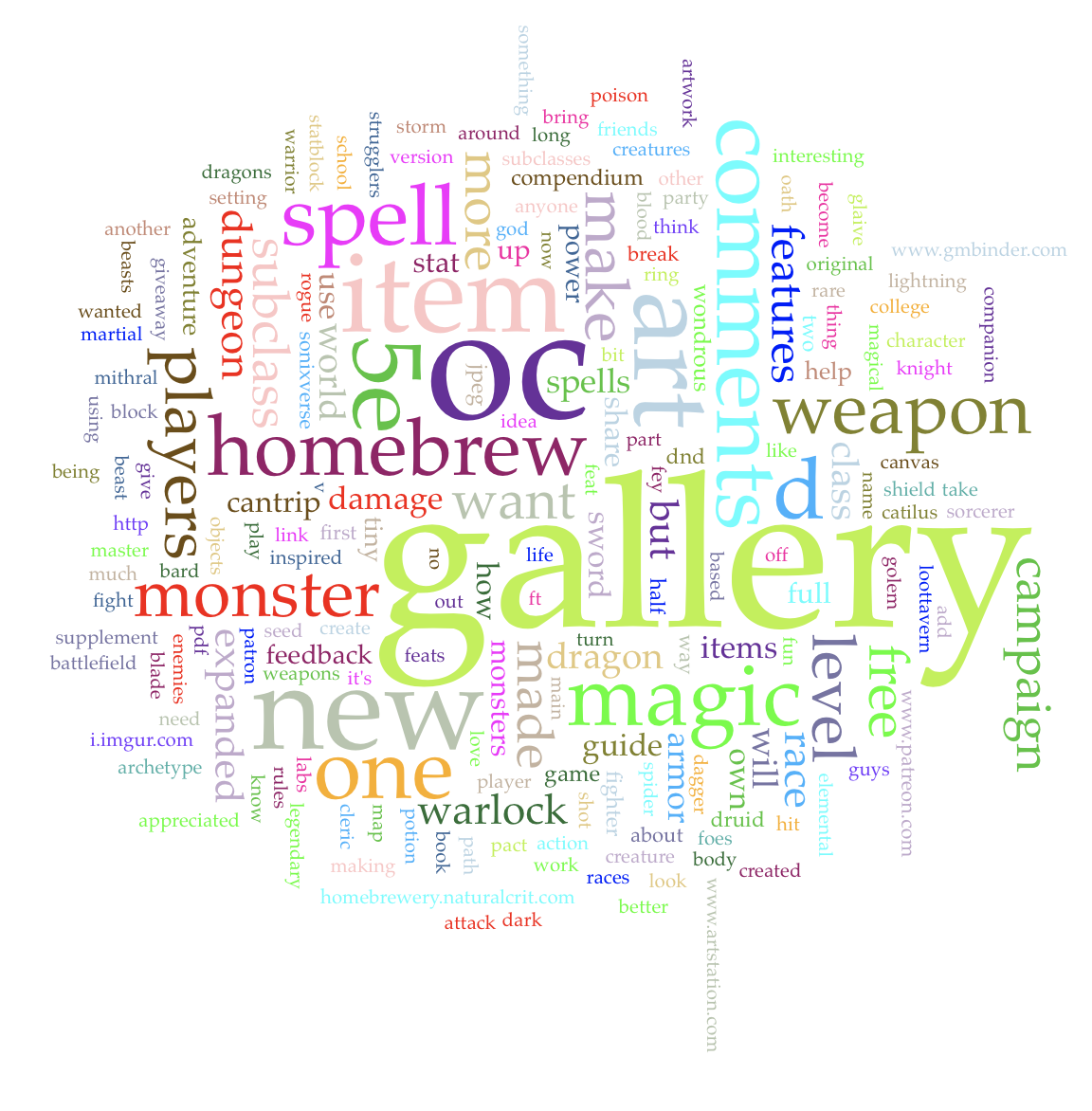
Figure 1. Voyant Cirrus of Homebrew Posts on Reddit. Created December 28, 2024, by Austin Anderson using Voyant.
[4.4] The comments on r/DnDHomebrew helpfully reveal some of the major concerns that commenters expressed toward various homebrew elements. "Damage" (188) was by far the most used word across the top one thousand comments on r/DnDHomebrew, and the frequent use of "damage" and related terms like "attack" (51) and "falling" (58) suggests that the users of r/DnDHomebrew are keenly interested in the mechanical impacts of various homebrew elements (figure 2). The comments on r/DnDHomebrew also frequently use qualitative descriptors like "bad" (81), "good" (271), "stupid" (38), and "amazing" (29), and the use of these terms affirm the review focus of r/DnDHomebrew.
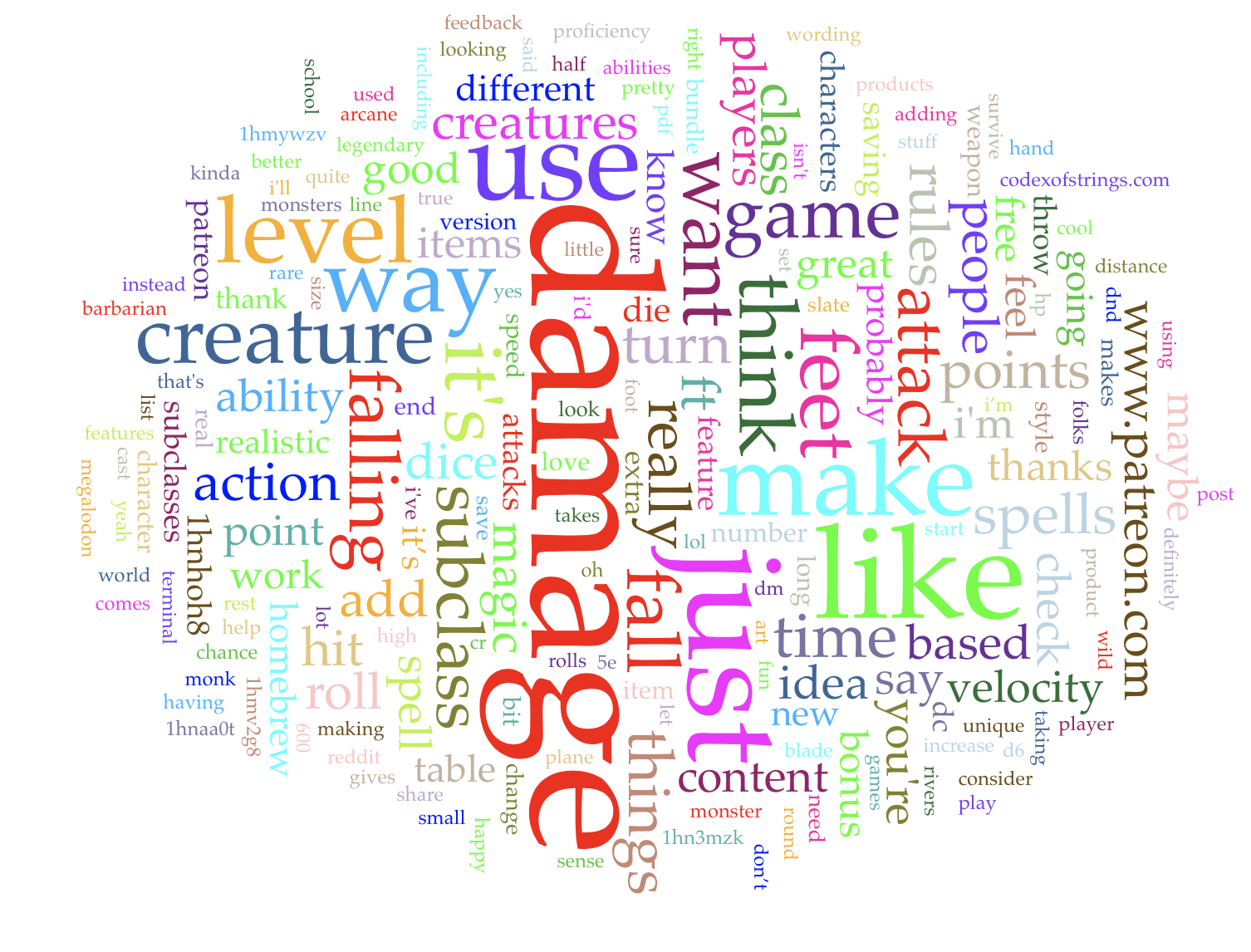
Figure 2. Voyant Cirrus of Reddit comments on r/DnDHomebrew. Created December 28, 2024, by Austin Anderson using Voyant.
[4.5] r/DnDNext is a subreddit focused on the next edition of the game that is currently known as Dungeons and Dragons Next. The subreddit asks users to limit homebrew discussion by only posting "one new homebrew thread per day." Even with these restrictions, homebrew has been mentioned 110 times across the corpus of posts. The collocates and correlations with homebrew across the corpus reveal some of the focuses of the conversation such as "communicated" and "balanced" (figure 3). Similarly, the comments on r/DnDNext include fifty-eight mentions of homebrew, and the link chart of terms associated with homebrew shows how varied the conversation is around the topic.
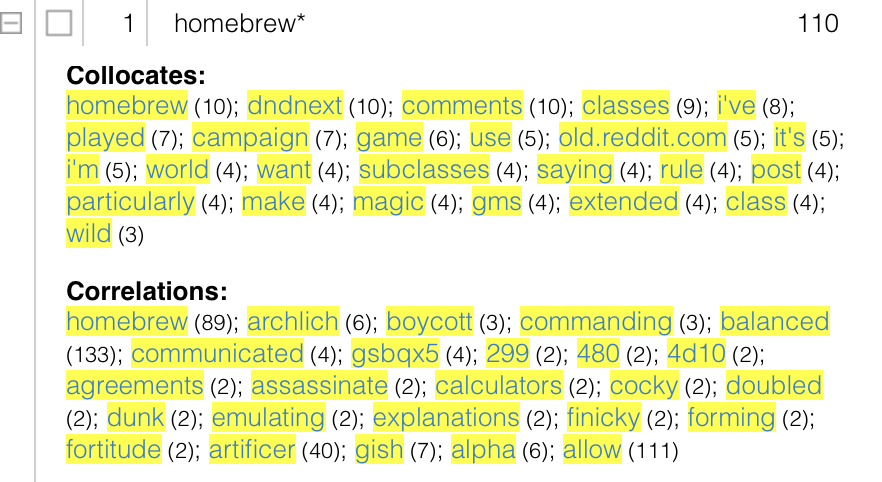
Figure 3. Voyant correlations of Reddit posts on r/DnDNext. Created December 28, 2024, by Austin Anderson using Voyant.
[4.6] The largest subreddit r/DnD includes almost no discussion of homebrew with only seventeen mentions in the posts and forty-nine across the comments (figure 4). This disparity suggests that homebrewing might be less popular among the broader and more general audience of r/DnD compared to its more niche-focused counterparts. In fact, one of the most popular posts on r/DnD is a 2020 post from Matt Mercer titled "With the Explorer's Guide to Wildemount announcement…" and the post includes one of the subreddit's few mentions of homebrew. Mercer writes, "I also wanted to comment on the occasionally-invoked negative opinions on my homebrew designs I've seen here…and they aren't wrong!" (https://www.reddit.com/r/DnD/comments/eo5mj7/with_the_explorers_guide_to_wildemount/). This remark acknowledges the critical reception Mercer's homebrew has received from the subreddit and hints at a broader skepticism toward homebrewing within parts of the D&D community. This hesitance may stem from the subreddit's preference for official content or its more mainstream audience, which might view homebrewing as overly complex or unnecessary.
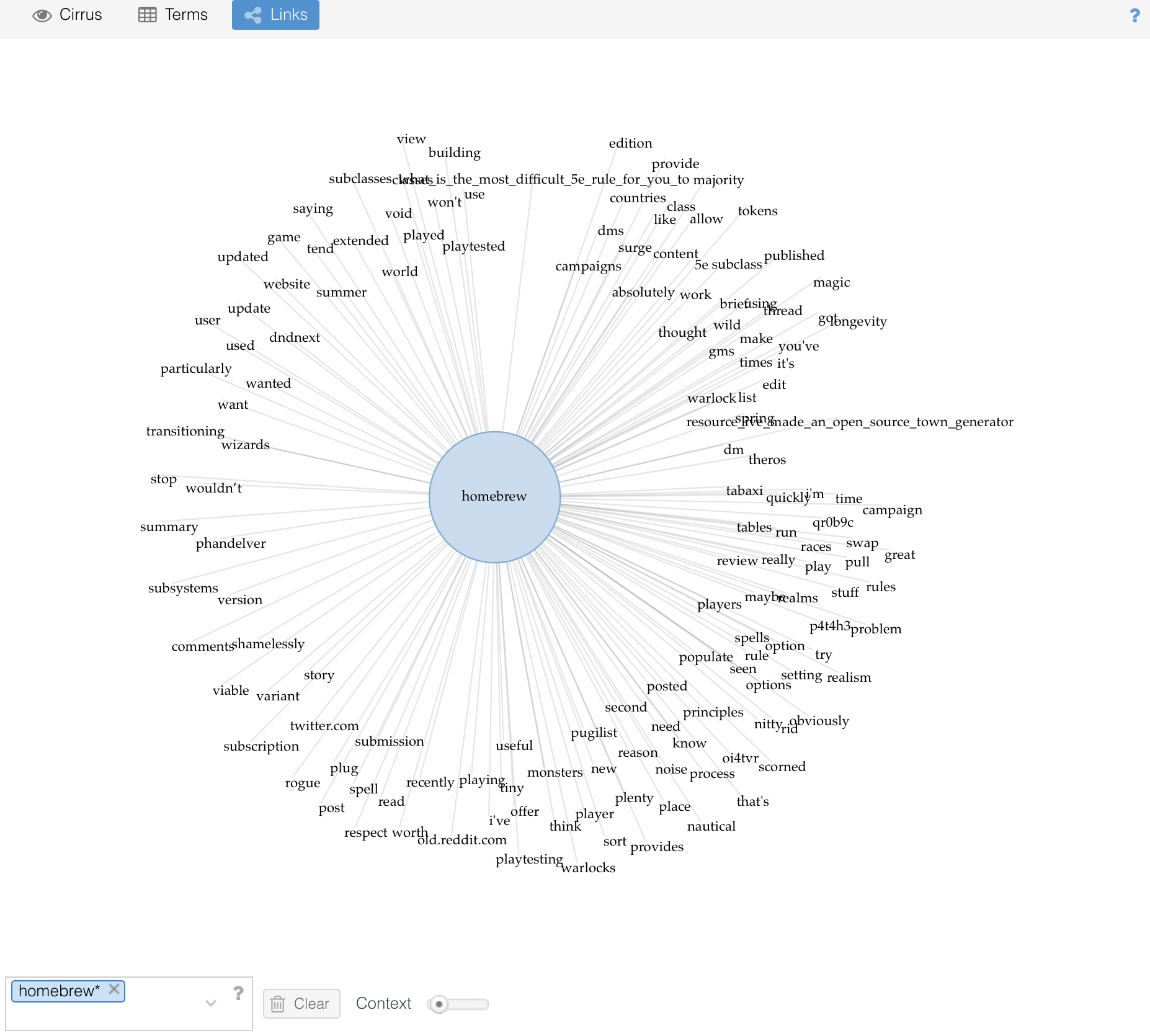
Figure 4. Voyant links of homebrew on r/DnDNext posts. Created December 28, 2024, by Austin Anderson using Voyant.
[4.7] Finally, r/DMAcademy—a subreddit designed for "Dungeon Masters to ask [and answer] questions"—provides a more robust platform for discussing the practical aspects of implementing homebrew content. With 152 mentions of homebrew in posts and fifty-six in comments, the discourse leans toward action-oriented terms like "running" (10) and "run" (8) and reflects the DM-centric focus of the subreddit (figure 5). Posts such as those asking for advice on running a seafaring homebrew campaign highlight a collaborative effort to design mechanics adaptable to various narrative scenarios. Meanwhile, other posts discourage first-time DMs from running a campaign in a homebrew setting, and these posts suggest a recurring skepticism among more experienced DMs about the wisdom of starting with homebrew content. This dynamic reveals that while homebrewing is celebrated as a creative tool, it is also approached with caution, particularly by those emphasizing mechanical balance and DM experience. The varied engagement with homebrew content across these subreddits highlights the diverse responses toward homebrewing within the online D&D community. The special focus on gameplay balance likewise reflects a gaming culture interested in mastery and power, another congruence between homebrewing and white geek masculinity.
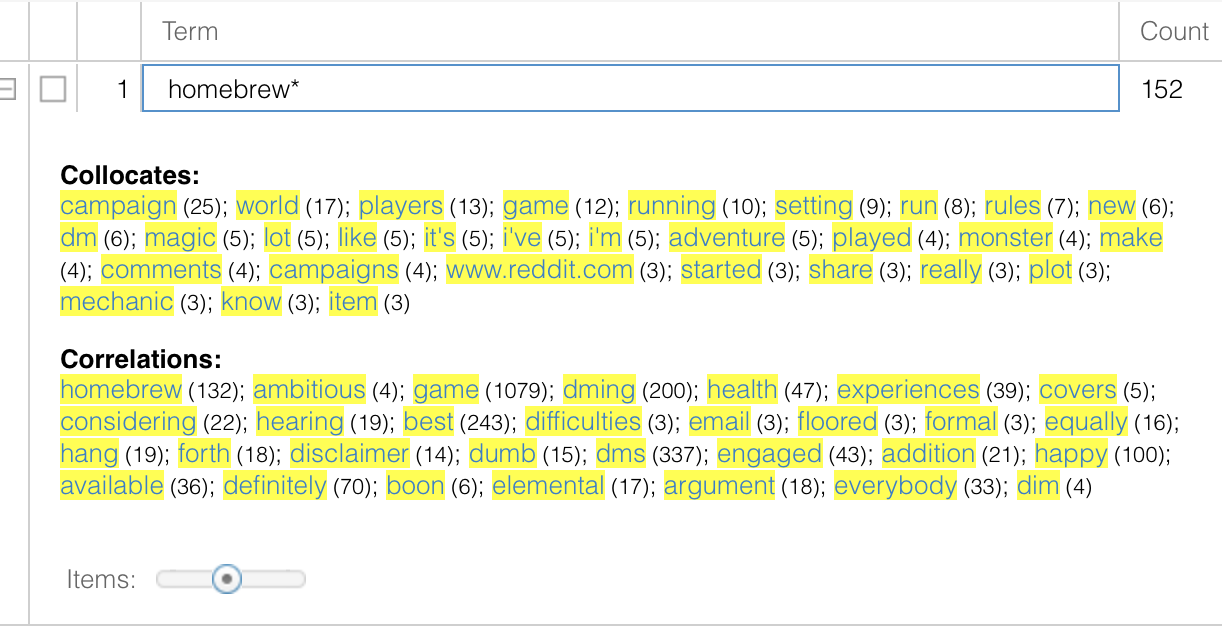
Figure 5. Voyant collocates of r/DMAcademy posts. Created December 28, 2024, by Austin Anderson using Voyant.
5. Taxonomy of homebrew
[5.1] With this understanding of homebrewing's significance throughout the history of D&D and the rising popularity of homebrew discussion on D&D-focused subreddits, I now offer a taxonomy of homebrewing today. While homebrewing often involves creating a custom setting or unique lore, my focus is on instances where homebrewing modifies official rules or impacts dice rolls. This focus stems from an observed dichotomy in both my own playing and research: while homebrewing settings are widely accepted and uncontroversial in the D&D community, homebrew mechanics often ignite lively debates regarding their merits and drawbacks. Further, online discourse indicates that most contemporary home games take place in homebrewed settings, and it is certainly true that most APs occur in homebrewed worlds. Homebrew mechanics, by contrast, are common in both home games and APs, but their adoption can provoke controversy.
[5.2] Based on the subreddit data and a review of select YouTube videos from the creators Home Brew Club, Dungeon Dudes, Bob World Builder, Geek and Sundry, and XP to Level 3 as well as forums including ENWorld, DnDBeyond, and Paizo, I propose five general categories of homebrewing practices that are common in contemporary D&D culture:
- [5.3] Banning Spells/Items/Classes/Races: Emerges from a desire to simplify gameplay, address perceived imbalances in the official rules, or ensure a cohesive narrative. For instance, on r/DnDNext, 369 DMs claim that they ban "silvery bards" because it is "perceived as overpowered." Likewise, several DMs discuss banning the artificer class on r/DnD because of a preference for Medieval-set campaigns, which they believe the artificer is incompatible with.
- Modifying Spells/Items/Classes/Races: Adjusting official mechanics without outright banning something. Like banning, this homebrewing practice is often done to simplify gameplay, address perceived imbalances, or ensure a cohesive narrative. Modification is likely the single most common type of homebrewing, and it is often cited as a nice middle ground between player freedom and the DM's goals. For instance, on a r/DnDNext post, DMs discuss different house rules to manage flying races, which are often perceived as overpowered.
- General Looseness Around Rules: Embracing a flexible approach to D&D's mechanics, prioritizing storytelling over strict adherence to rules. This might involve permitting creative interpretations of skill checks or altering combat rules for narrative purposes—a practice often championed under the "rule of cool." For example, one of my home games allows players to use Bless for skill checks while Bob World Builder describes how his table "almost entirely ignor[es] the concept of movement speed" (2023). This flexibility is common in D&D but can inspire significant debate, such as the dozens of Reddit posts complain about the "rule of cool" being overused.
- Adding New Spells/Items/Classes/Races: Allows DMs to introduce custom content to expand their table's narrative and mechanical possibilities. Additive customization is what many think of when we say homebrew as it requires complete invention on the DM's part. Perhaps for this very reason, this type of homebrewing inspires the most debate as there are dozens of Reddit and forum posts where players discuss the best and worst homebrewed rules they have encountered.
- Incorporating Materials from Other TTRPGs: Drawing from other TTRPG systems to modify that material for D&D. Many DMs will draw on systems like Call of Cthulhu or Blades in the Dark in their D&D campaigns. Typically done to expand some of the limitations of 5E and explore different modes of play. For instance, there are many forum posts discussing incorporating Call of Cthulhu's "sanity mechanic" into D&D games.
[5.4] These five homebrewing practices represent the most common types of homebrewing in D&D as identified across the subreddit communities and other online discussion of homebrewing. These categories are not always distinct from one another as there is often significant overlap between the practices. For instance, creating a custom monster might involve designing unique mechanics while adjusting a stat block for an existing monster. Similarly, crafting a new spell might draw inspiration from another TTRPG system. With an acknowledgment of homebrewing's fluidity, this framework offers a useful general taxonomy to understand the diverse ways D&D DMs and players engage in homebrewing.
[5.5] While homebrewing is nearly ubiquitous in D&D games, not all homebrewing practices are equally well received. Online discussion reveals five general categories of receptions of homebrewing in D&D:
- [5.6] Criticism for Diverging from D&D's Purity. Many players argue that homebrewing dilutes the essence of D&D. This critique is particularly common in communities that emphasize a canonical D&D experience and view rule alteration as unnecessary or disruptive.
- Criticism for Suboptimal Balancing. A frequent point of contention in online forums is the perceived lack of balance in homebrew mechanics. Players often debate whether a homebrewed spell, class, or item might disrupt the game's equilibrium. This critique is especially pronounced in discussions around power gaming or when players feel that a DM's homebrew is undermining the strategic aspects of their gameplay.
- Just Play a Different System. An increasingly common critique of homebrewing is that the table should just play a different system rather than trying to make D&D something that it isn't. While this critique is sometimes an offshoot of the purity critique, it is increasingly leveraged by players who desire a break from D&D and are advocating for alternative systems.
- Praise for Creativity. Many players celebrate homebrew as a form of creative expression. The rule of cool mentality of prioritizing fun over strict adherence to mechanics is often invoked to celebrate innovative homebrew elements.
- Praise for Addressing a Social Justice Failing of D&D. A growing number of DMs use homebrewing to challenge problematic elements within D&D such as its historical ties to orientalism, racism, and sexism. From this perspective, thoughtful homebrewing can be an excellent way to introduce more inclusive narratives and value systems within D&D.
[5.7] The intersection of homebrewing and social justice—advocacy for structural change and sociopolitical rights for the historically oppressed—is particularly compelling because it reveals how contemporary D&D communities use homebrew to combat the white suburban geek masculinity that informs the history of D&D homebrewing. Embracing homebrewing can trouble these elements while also pushing against the "rules lawyers" who, according to Dashiell, rely on the "symbolic and linguistic capital" that comes with an intimate understanding of a game's rules that simultaneously serves "as a means of reinforcing masculine power" (2017). Thoughtful homebrewing provides an alternative. Yet, this expectation can create new problems, which is particularly apparent when we compare the reception of homebrewing in different APs.
6. Reception to Aabria Lyengar's homebrewing
[6.1] In this section I turn to a case study of fan reception of Aabria Iyengar's homebrewing practice across the AP show Dimension 20. An AP is a genre where "participants are recorded playing tabletop roleplaying games (TTRPGs), and this recording becomes the primary element of an audience-facing performance" (Alberto and Friedman 2025, 150). AP fandom is not synonymous with TTRPG culture: TTRPGs long predate APs, and many TTRPG players have no interest in APs and vice versa. However, Alberto and Friedman describe an increasingly reciprocal relationship between AP fandom and TTRPG culture: "as its own popularity has grown, actual play has significantly raised the profile of TTRPGs—particularly D&D—in the cultural zeitgeist" (2025, 151). For instance, survey data shows that most AP watchers are also TTRPG players (Stanton and Johnson 2021). Thus, while AP fandom represents only a subset of TTRPG culture, it can provide valuable insight into contemporary player expectations and practices. The conclusions drawn from this case study should not be overgeneralized to claim that it reflects the entirety of TTRPG homebrewing. However, it does offer a focused perspective—albeit a limited one—on how homebrewing is perceived within AP fandom, which offers some insight into homebrewing in the larger TTRPG culture.
[6.2] Iyengar's runs on Dimension 20 offer a compelling case study for examining the receptions of homebrewing in popular APs. Her DM's seasons—two seasons of Misfits and Magic (MaM), A Court of Fey and Flowers (ACoFaF), and Burrow's End (BE)—showcase various homebrews. In MaM, Iyengar plays with the Kids on Brooms system but integrates her homebrewed "common fucking sense" dice mechanic as a critique of the Harry Potter universe's illogical structure. This homebrew addition received widespread praise from the Dimension 20 fandom, and its inclusion was seen as both humorous and critical. Similarly, in ACoFaF, Iyengar used 5E as a foundation but heavily adapted it with homebrewed mechanics inspired by Good Society to reflect the social intricacies of a Regency-era setting. These modifications emphasized themes of status, reputation, and decorum, encouraging gameplay that aligned with the narrative's thematic core. Fans and critics alike lauded ACoFaF for its innovative mechanics, which demonstrated how homebrewing can elevate storytelling by aligning rules with the genre and tone of the campaign.
[6.3] However, the fan reception to BE presented a stark contrast. Iyengar opted for a largely unaltered 5E system, which many viewers found underwhelming given her track record of innovative homebrewing. While BE was still praised for its poignant storytelling and character work, some fans expressed disappointment with the lack of mechanical iteration. This reaction was compounded by the broader controversy surrounding the Open Gaming License (OGL) in 2023, which had already cast a critical light on 5E as a system. For some viewers, the absence of homebrewed mechanics in BE felt like a missed opportunity to push back against the constraints and embedded value systems of 5E, particularly in a season that explored community and environmentalism. Yet, it is notable that Iyengar's decision to largely forego homebrewing in BE was rooted in a desire to confront D&D as a system. In an interview with GameSpot, Iyengar says:
[6.4] Picking [D&D 5E] was definitely intentional. It was a chance to talk about what this system does, frankly, too well. D&D handles power really well, but it also teaches you to treat problems as fight triggers. So knowing that this table was brilliant, filled with wonderful storytellers, I knew I could keep handing them problems and ask, "Will you keep throwing punches at it?" And that's why there were always alternate solutions to problems […] It just so happens that D&D [as a system] and I were constantly reminding them, "You are stoats, you are predators. You are exploiters as a part of your nature. Will you do that again here?" (quoted in Ramée 2023)
[6.5] When we return to the taxonomy of homebrew, Iyengar engaged in an artful refusal of using homebrew to enact a social justice critique of D&D. Instead, she forced her players—and, by extension, the viewers—to confront the values embedded within D&D by refusing to homebrew. In rejecting homebrew, Iyengar used D&D's system to encourage problem solving through violence, which was, then, used to critique the white geek masculinity at the heart of TTRPG culture.
[6.6] Ultimately, the differing receptions to Iyengar's homebrewing choices highlight the heightened expectations placed on AP creators and reflect evolving audience values. That audiences expect homebrewing from AP DMs likewise suggests that homebrewing is valued in the AP community. Iyengar's success with MaM and ACoFaF demonstrates how homebrewing can enrich storytelling and foster positive engagement while the response to BE underscores the challenges of satisfying a fanbase attuned to the potential of TTRPG systems to interrogate and expand their narrative boundaries. This case study exemplifies how homebrewing is a central practice in AP with expectations that reflect the homebrew taxonomy while both confronting and reifying the white geek masculinity of TTRPGs and homebrewing as a historical practice.
7. Conclusion
[7.1] Homebrewing, both historically and today, reveals the dynamic and participatory nature of D&D as a game and cultural practice. Homebrewing allows players to participate as coauthors, and DMs can tailor their games to their specific needs while interrogating the assumptions embedded within D&D itself. From fostering inclusivity through socially conscious alterations to sparking debates over gameplay integrity, homebrewing is a fan practice that allows for varied and nuanced critical play and sometimes cultural reification. Homebrewing is particularly notable for those of us interested in the overlaps between social justice and TTRPG culture because homebrewing both reflects and challenges the larger value systems embedded within D&D, and close attention to homebrewing can help scholars understand the nuances of contemporary TTRPG culture.
8. Acknowledgments
[8.1] I am grateful to the anonymous reviewers, Taylore Nicole Woodhouse, Emily Kugler, Em Friedman, Kyle Cunningham, P.S. Berge, and the participants at Analog Game Studies 2024 for their insightful suggestions. I would also like to acknowledge my long-running D&D group—the E.E. and the B.A.B.—for informing this research.