1. Introduction
[1.1] Defining science fiction (SF) as both a literary genre and a community, as Justine Larbalestier (2002) and Helen Merrick (2009) do, makes it possible to show the active work of fans. These ethnographic approaches, as Robin Ann Reid underlines (2014), shed light on the work of marginalized people, often erased from the cover pages and overlooked by awards. They also contradict the theoretical and literary theses that either highlight SF as a discrete body of (inherently) political literature (Suvin 1972) or reduce feminist SF and the New Wave to marginal political groups (Besson 2021). These scholarly approaches show that feminist SF was primarily the product of actions from female readers who were strongly integrated into fandom and used the subgenre to consolidate their presence as women—and sometimes as feminists.
[1.2] The object of my research is the social space of fans and writers with their situated definitions of feminism and SF, what L. Timmel Duchamp (2004) calls the "grand conversation." Even though Merrick (2009) speaks of feminisms in SF to underline the plurality of the use of this object, I will use the term "feminist SF" to match the label used by fans and writers in the 1970s in order to highlight the practices and struggles around it and the space of experimentation it denoted.
[1.3] My research began as an attempt to understand what French SF fandom calls "science-fiction féministe," which usually implies a sort of global history of women's SF writings. For example, Ïan Larue (2018), author of Libère-toi Cyborg!, mentions a 1986 "Open Letter" published by the feminist editor Jeanne Gomoll in the fanzine Aurora as a key moment in the feminist history of SF. Larue then refers to the "cyborgian writers" list in Donna Haraway's Cyborg Manifesto (1991) and calls for the creation of a similar feminist SF reading list. Quite tellingly, Larue mixes queer, theoretical, women's, and feminist writings. Along with Ketty Steward’s Le Future au pluriel (2023), Larue is a rare example of an author from the mainstream French SF community to speak from fandom and to refer to fan history when discussing feminist SF. They mostly do so by referring to the English-speaking fandom's history. Furthermore, closer to literary studies, recent French editions and translations of Joanna Russ, such as Charlotte Houette and Clara Pacotte's, refer to the same periods of American feminist SF (the 1970s–1980s) as key to their narrative.
[1.4] These fandom discussions led me to study fan narratives of 1970s–1980s North American feminist SF. To avoid presenting the dominant narrative of 1970s feminist SF present in the French fandom as the sole accurate recollection of the period, I conducted archival analysis, coupled with interviews of women editors of the fanzines Janus, Aurora, New Moon, Khatru, and The Witch and the Chameleon (WatCh) (note 1). This methodological pluralism, favored in fan studies, strives not for the objective "view from nowhere" but highlights conflicting perspectives and makes the researcher's position explicit among them (Cristofari and Guitton 2015).
[1.5] I defend two hypotheses: first, that collective memory drives and structures feminist fan practices and forms a point of convergence between fandoms and feminism; second, that collective memory serves as an entry point for understanding power dynamics in feminist fandoms. I develop a more systematic conceptualization of collective memory in fandom to complement existing works on power dynamics in fan archiving. I develop a conceptual framework inspired both by concepts from French sociology of culture and Anglophone academic literature on memory.
2. Collective memory frameworks and mnemonic practices
[2.1] Human memory is inaccurate: The past is a "substitute experience" where the imagination of the present allocates emotional value (Dewey 2014). Memory is about the past but can only be understood sociologically in the present. Thus, memories recounted during interviews "often betray a collective imagination as well as embodying truths of a more personal salience" (Kuhn 2002, 9). Collective memory is made of forgetting and remembering processes (Weedon and Jordan 1992). Star Trek fans interviewed by Camille Bacon-Smith (1992) select from their memory what relates to recurring characters, with particular attention to insignificant details that contradict the fan canon. Matt Hills (2014) shows how the memory of Doctor Who fans emphasizes certain periods of the series to the point of homogenizing their understanding of the plot and their stories of initiation to the series (and to the fandom). Groups manifest themselves through memories as frames and therefore cannot be considered solely from an individual or psychological point of view (Halbwachs 1950). The fan community frames memory activity: We remember according to the stakes of the group, to show our belonging to this group and, in so doing, we reinforce the collective framework.
[2.2] The transmission and circulation of collective frames (for example, epiphany narratives) depend on memory work, writing technologies, and spaces of inscription. Examples of the latter include fanzines, awards, rankings, archives, and fan wikis. These spaces play an active role in the transmission of SF themes, tropes, and evaluation criteria. Drawing on sociologist Bernard Lahire's "literary autonomy" (2006), I call this role "symbolic autonomy" as I focus on the feminist SF grand conversation and not the overall literary world. This autonomy refers to the ability to design a self-referential corpus, that is, one that uses evaluation criteria specific to feminist SF and its community. The French sociology of culture traditionally distinguishes two forms of relationship between individuals and cultural objects: (1) ethical reception, which links works of art to everyday life, and (2) aesthetic reception, which analyzes them using abstract and sophisticated criteria. The latter is more common among members of dominant cultural groups, such as cisgender white men, who are socialized to an abstract relationship with culture (Sellier 2023; Albenga 2017) and who have more tools at their disposal to record their achievements (Russ 2018). Designing technologies of writing and spaces of inscription sustains the grand conversation; memory work helps organize a community and creates a self-referential discussion with common references and criteria to evaluate stories on feminist standards. The transition from ethical to aesthetic relation to cultural products does not mean that ethical impulses disappear, as Neta Yodovitch shows (2022); it is a permanent impulse in the double identity of feminist fans. However, this transition denotes the collectivization of this ethic, such as the collective defense of feminist spaces of experimentation. I use the dichotomy ethical/aesthetic to illustrate a rupture, a turn to memory activism, that does not exist cognitively for the fans and writers themselves.
[2.3] According to De Kosnik (2016), fan archives are a force of democratization that, through a proliferation of interpretations, destabilize traditional (and academic or authoritative) forms of collective memory. This approach underlines the continuous archival labor of fans and, through it, fans' ability to blur the boundaries between the cultural text and their performances, between the canon and their repertoires. As a result, fan archive subcultures converge with queer subcultures insofar as they form marginal and plural spaces that share the same politics of memory, such as rewriting grand narratives, rediscovering forgotten writers and contesting heteronormative readings.
[2.4] I must, however, introduce a methodological proviso. Fan studies focus on the authority of the archive, "often made to reflect certain hierarchies and power dynamics between community members with different levels of fannish prestige or expert knowledge" (Jansen 2022). E. Charlotte Stevens and Nick Webber (2022) use the notion of "fan-historian" to describe fan specialization in this work and how researchers engage in the competition of interpretative authorities. Jack Halberstam talks of the academic as a "coarchivist" and a "participant in the subcultural scene" (quoted in Lothian 2012, 549). There is no vantage point: The researcher is part of these relations of authority and legitimization.
[2.5] The second task is a nuanced application of De Kosnik's (2016) ideas of fan archives to printed materials fandoms. Not all fan archiving tends toward proliferation or converges with queer politics; archives are framed by dominant and contested narrative patterns, specific to fandoms. In Dennis Jansen's words (2022), archives "reinforce the hierarchical relationship between the archive's guardian and its users" and reproduce the social inequalities existing among fans (some have free time, are wealthier, have higher education, an academic position, etc). While keeping De Kosnik's idea that fan archiving is often a contentious practice, I add nuance to the suggestion that it is an inherent ethic. We should study how and when fan archives converge with queer/feminist practices and identify the exclusions at play since such convergences reproduce fandom power dynamics. Neta Yodovich shows that the fans are conscious of the "symbiotic relationship" between the representation of fans, writers, and women fiction characters (the visibility of one condition the others) (2022, 130). This relation—theorized quite early on by Badami in 1976—becomes a site of reciprocal obligations, the duty of memory encompassing women characters, fans, theoreticians, and writers. That is why focusing on memory activism and archiving is important; those are places where political coalitions are made or broken and where interpretative authorities crystallize.
[2.6] Definitions of memory activism emphasize its non-institutional and contentious character. I organized this article around Charpenel's (2014) social conditions of feminist collective memory and Ann Rigney's (2021) "activism-memory nexus." The latter defines "the mutual entanglements and feedback loops between memory activism, memory of activism, and memory in activism" (301). (Both are synthesized and adapted in the Appendix and reincapsulated in figure 1.) The latter shows the self-reinforcing nature of the group dynamic, which leads to the institutionalization of the collective memory of the feminist SF subgenre. Symbolic autonomy qualifies the fans' ability to build and legitimize the use of their criteria of evaluation for literature that embodied their feminist identities. It supposes a collective frame supported by memory technologies and answers the question of knowing what makes SF fans and feminist practices converge and what the power dynamics are at play.
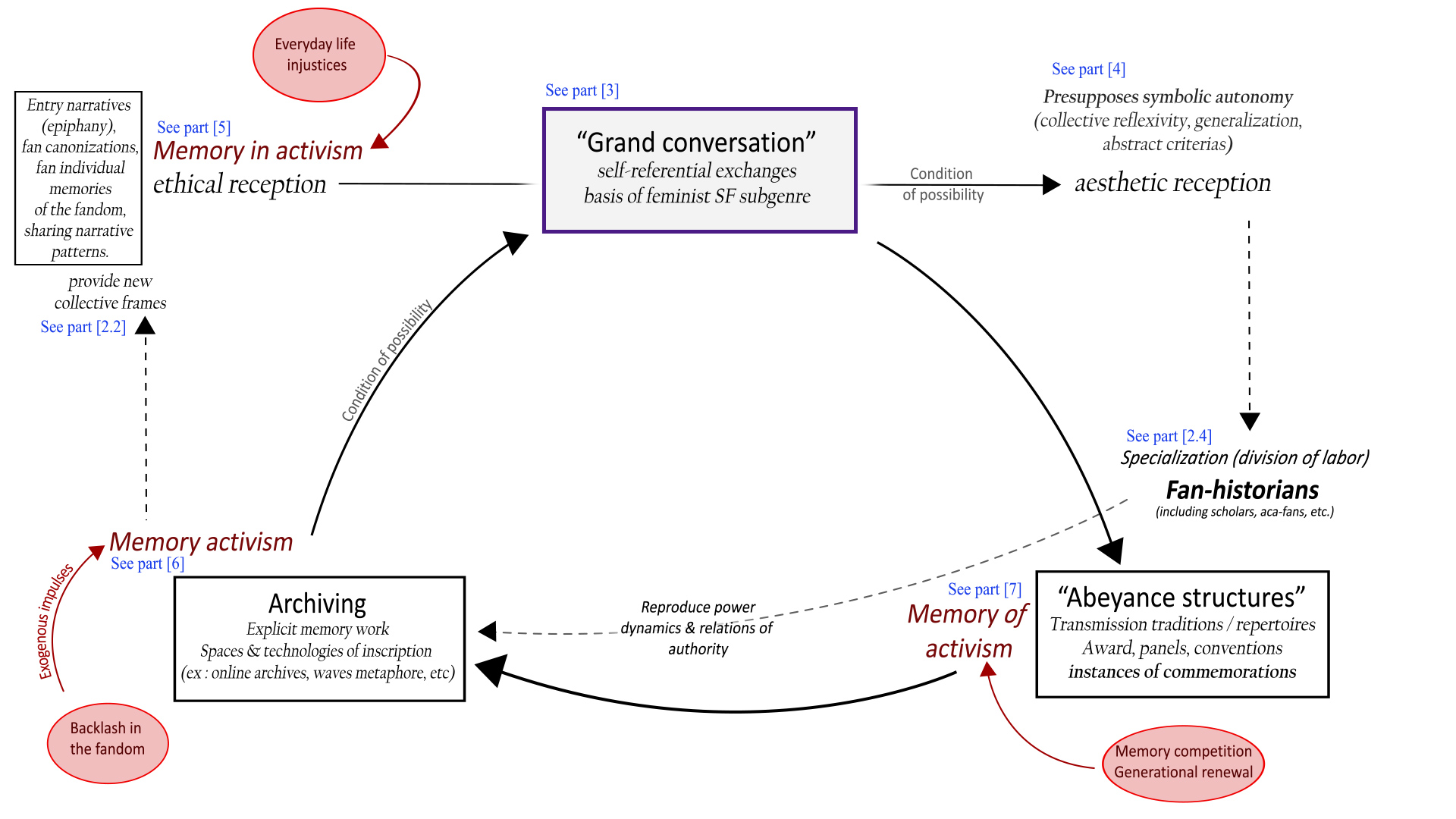
Figure 1. Memory-nexus reinforcing cycles as conditions of feminist SF grand conversation. Created by the author.
[2.7] To explain the initial driving forces of these dynamics, I added at each corner of the triangle some exogenous impulses. The process starts with women fans' ethical commitment to cultural objects, underlined by their discovery or epiphany narratives, reinforced by their specialization in memory work, motivated by the cultural backlash, weakened by the competition with other authoritative memories, and contested by newer generations. Incidentally, those impulses limit the self-reinforcing autonomy of the grand conversation. In the following sections, I contextualize North American feminist fandom of the 1970s and the construction of its symbolic autonomy, and I show the centrality of the fannish canonization process in shaping both personal and collective memories. The latter sections qualify the idea of a consensual collective memory to show heterogeneity of the community, first through the case of fan herstories competing with feminist academic narratives, then about generational challenges posed by the preservation of sometimes-excluding 1970s memories.
3. Feminist spaces in North American SF and their autonomy
[3.1] North American literary fandoms grew out of reading groups in local chapters that organized conventions starting in the late 1930s (Mendlesohn 2014). Narratives of women's entry or "invasion" recur in the history of these fandoms (Merrick 1999, 118). However, the specificity of the late 1960s discourses of invasion is to refer to women politicized in the context of feminist movements (Bacon-Smith 2000), such as American writers Joanna Russ and Vonda McIntyre, as well as Canadian and US fan editors Susan Wood, Amanda Bankier, Janice Bogstad, Jeanne Gomoll, and Diane Martin. These fans were critical of SF fandom's disconnection from social change among women fans and writers who had "made their peace" with male fans (Wood 1978, 6). It is possible to observe the continuity between feminist and fan identities; the frustrated identification with both motivates the production of content (fan fiction, cosplays, reviews, etc.) that aims at reconciling fandom and feminist engagement (Yodovich 2022).
[3.2] Women readers were present and visible from the very first issues of Amazing Stories in 1926, the magazine of Hugo Gernsback, inventor of the term "science fiction" (Larbalestier 2002). Until the 1970s, women fans were "neutralized": "companions of a male fan" or "honorary male" (Wood 1978). The situation changed when their voices were amplified by feminist movements. The fans who edited the first SF fanzines claiming to be feminist—WatCh and Janus—were SF readers politicized during the student, antiracist, and anti–Vietnam War movements (note 2). They had little prior knowledge of the fandom: Janus editors came from farming or working-class families and completed short post-secondary programs at the University of Wisconsin-Madison (note 3). They were joined by local fans who helped them edit their fanzine and send it out to well-known fans. In 1975, they introduced themselves as "fem-fans" (Bogstad and Gomoll 1975, 40).
[3.3] Feminist fanzines appeared between 1974 and 1975 in the context of the New Wave movement and anthologies that brought together experimental and sometimes exclusively women's stories: Aurora: Beyond Equality; Cassandra Rising; Millennial Women; Women of Wonder; and Amazons!. Rox Samer (2022) refers to this ecology of books and fanzines as a counterpublic where feminist consciousness arises. The most active spaces were the fanzines' letter columns, where fans challenged women writers, whom they accused of reproducing sexist tropes (Bankier 1974; Charnas et al. 1976). For example, the "Darkover controversy," named after a multivolume series by Marion Zimmer Bradley, led to an exchange of letters in which fans accused Bradley of reiterating antifeminist ideas or erasing potential lesbian romances (note 4). After several heated exchanges, the author came out as bisexual and adopted the feminist language of the fans (Bradley 1977) and presented herself as a feminist at conventions (Kuras and Schmieder 1980). These discussions show how fans participated in the construction of feminist SF: by promoting publication, by creating their criteria for evaluating and recognizing the works with which they identified, and by providing a space for experimentation and a context of intelligibility for feminist writings (Samer 2022; Duchamp 2004) (note 5). Among the letters in these fanzines, readers can find the names of authors who would develop the academic feminist SF critiques over the following decades (Joanna Russ, Ursula K. Le Guin, Susan Wood, Janice Bogstad, Marleen Barr, etc.).
[3.4] These actions contributed to feminist SF's symbolic autonomy: a feminist SF culture engaged in the same discussions as queer and feminist subcultures. In the 1970s and 1980s, the mainstream debates on separatism and compulsory heterosexuality also ran through SF fanzines. Political lesbianism and separatist experimentation found their way into poetry magazines and speculative fiction, including Sally Miller Gearhart's The Wanderground and Suzy McKee Charnas's Motherlines—the publication of the latter being directly supported by Janus' editors. While this separatist impulse is later interpreted as symptomatic of a cultural retreat from political struggle (note 6), in the speculative fiction of the period, it is experienced as a liberation of creativity (Shugar 1995). In Native Tongue, Suzette Haden Elgin built a language, the Láadan, "constructed by a woman, for women, for the specific purpose of expressing the perceptions of women" (1988, 1). Láadan was also the product of informal exchanges and panels held at WisCon, a feminist SF-oriented convention founded by the editors of the fanzines Janus and Aurora. Elgin introduced the foundations of her language during her 1982 Guest of Honor speech: asserting that male power acting in language transforms reality, she proposed a counterlanguage with its own phonetic and grammatical system (1982). It used a variety of words to denote the diversity of women's experiences, for example: "Osháana" refers to menstruation in general; "Elasháana" to first-time menstruation; and "Wesháana" to late menstruation. Despite criticism that she homogenized women's experiences, she found support among fans in the face of publishing difficulties (1983). The notion of symbolic autonomy helps characterize fan intentions. In the eyes of the feminist community, these writers demonstrate what can be written once the frameworks of the great conversation have been established, once an audience of informed readers and writers has been constituted. Elgin herself called her invention a place of collective memory for feminists (1988).
4. Interlude: Methodology of the thematic analysis
[4.1] To analyze the three dimensions of the activism-memory nexus identified above, I conducted a thematic analysis on a sample of the corpus of fanzines. I selected Janus and Aurora (1) because of their mention in Francophone writings; (2) because they are the first fanzines, according to Merrick (2009) and Samer (2022), to explicitly adopt the label of "feminist SF" in North America; (3) and because they were accessible in France, both through their online availability and through scholarly works that provide their intellectual context. The thematic analysis covers all published columns and features of the fanzines (N=234). This analysis uses basic forms of encoding and serves to recognize regularities or progressive shifts. A fortiori, it brings into play the interpretive capacity of the researcher (Miles and Huberman 1994). The result of the thematic analysis highlights a shift toward self-referentiality: an active memory work responding to a perceived backlash and the construction of an aesthetic or edifying relationship with feminist SF.
[4.2] The goal of the thematic analysis is to show the emergence of the grand conversation through increasingly autonomous or self-referential conversations, placing the feminist community's criteria above exogenous criteria, SF fandom's criteria, or those of mainstream SF. This analysis complements the other aspects of my research, such as observations made during conventions and interviews. I observed the apparition and the institutionalization of the social conditions of feminist collective memory: a minimal consensus around a (feminist and fan) duty to memory, a shared corpus of SF stories and authors, and on the necessity of feminist politics in the SF community to protect women's place inside it (figure 2).
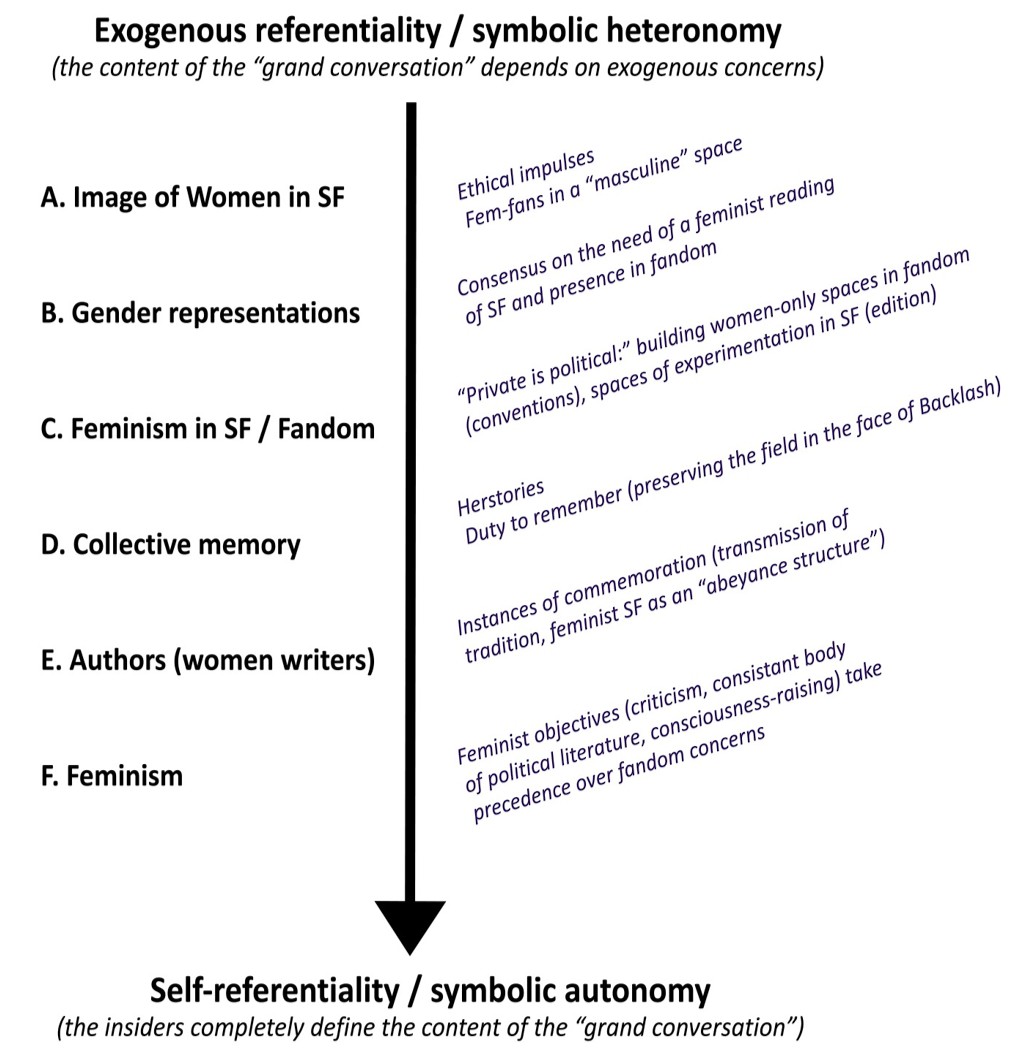
Figure 2. Thematic modalities relation with the "symbolic autonomy" conceptual framework. Created by the author.
[4.3] I have created two groups of modalities that take up the idea of an ethical relationship and an aesthetic relationship with cultural products. The modalities of the first group are "Image of women" (A) (texts that comment on the internal representation of women in fiction), "Gender representations" (B) (texts that comment on gender relations in fiction), and "Feminism in SF/fandom" (C) (attempts to define feminism in relation to fandom and/or SF). In the aesthetic relationship, I have put "Memory" (D) (explicit memory activism or intention to write the history of SF from a feminist/feminist point of view), "Authors" (E) (texts that give voice to or draw a biographical account of female authors) and "Feminisms" (F) (texts that comment on feminist thought or contribute to feminist discussion without making clear reference to the fandom). I then assigned a modality to each section (articles, essays, reviews…) published in Janus and Aurora. Figure 3 shows the evolution of each modality over time. Modalities that denote an aesthetic relationship with SF or edifying feminist writings increase in proportion to the total number of published sections (including poetry, fiction, criticism, art, etc.; figure 4). This translates into writings that engage directly in feminist discussions, with less reference to fandom—denoting self-referentiality—as well as writing that directly theorizes memory activism or the history of female authors—denoting memory activism (see figure 2 linking the categories to symbolic autonomy).
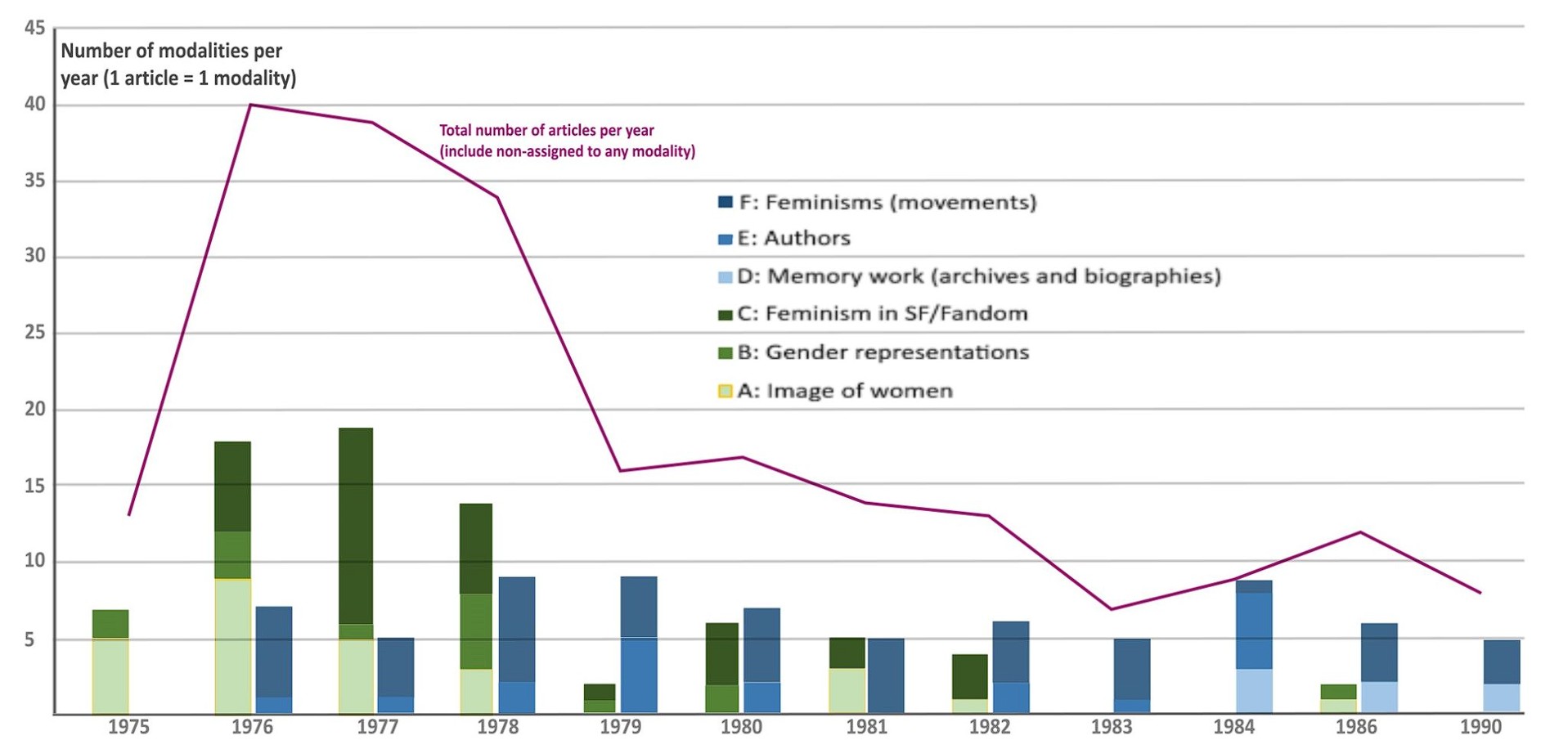
Figure 3. Number of modalities in Janus and Aurora per year (1975–1990). Created by the author.
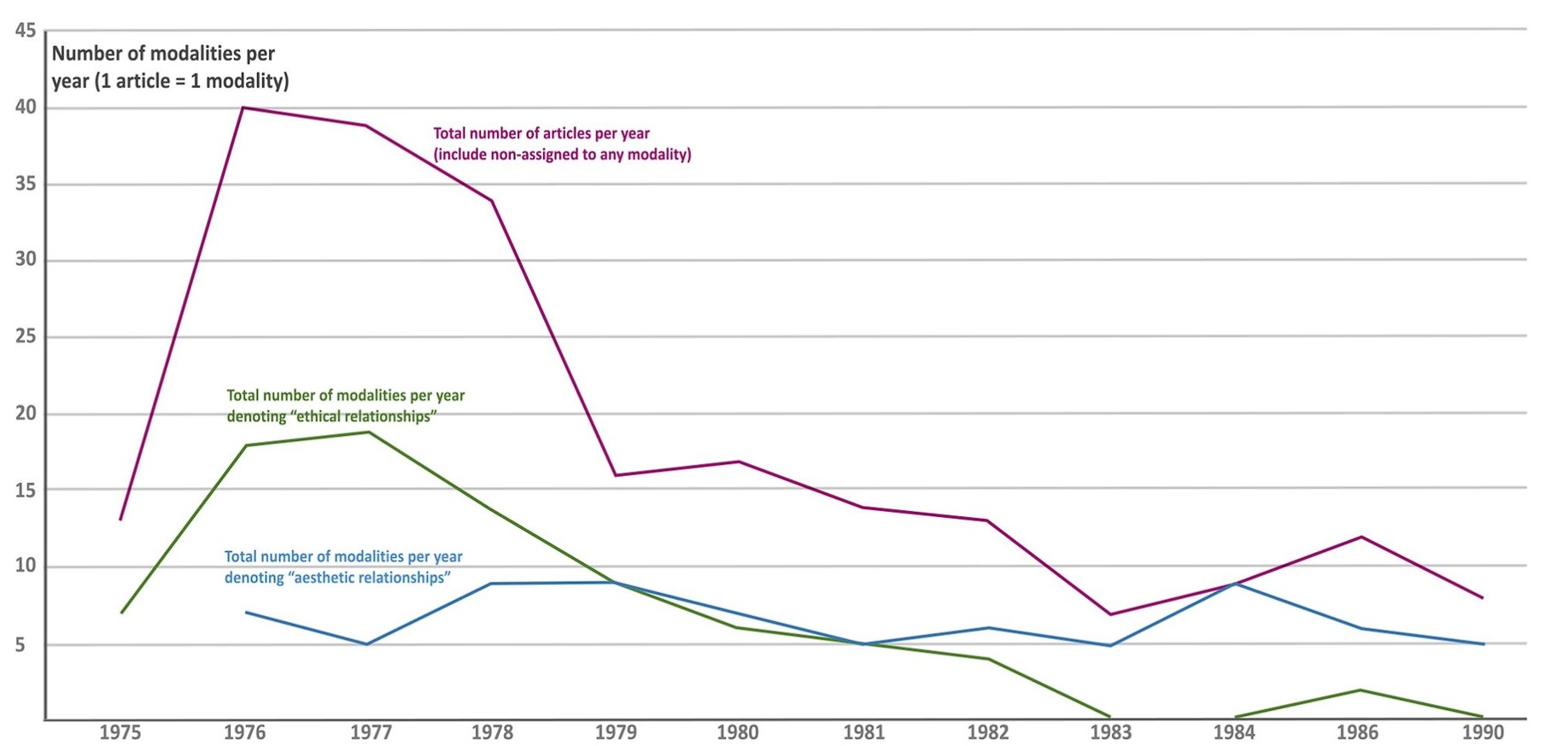
Figure 4. Evolution of modalities related to ethic and aesthetic relationships in Janus and Auroraper year (1975–1990). Created by the author.
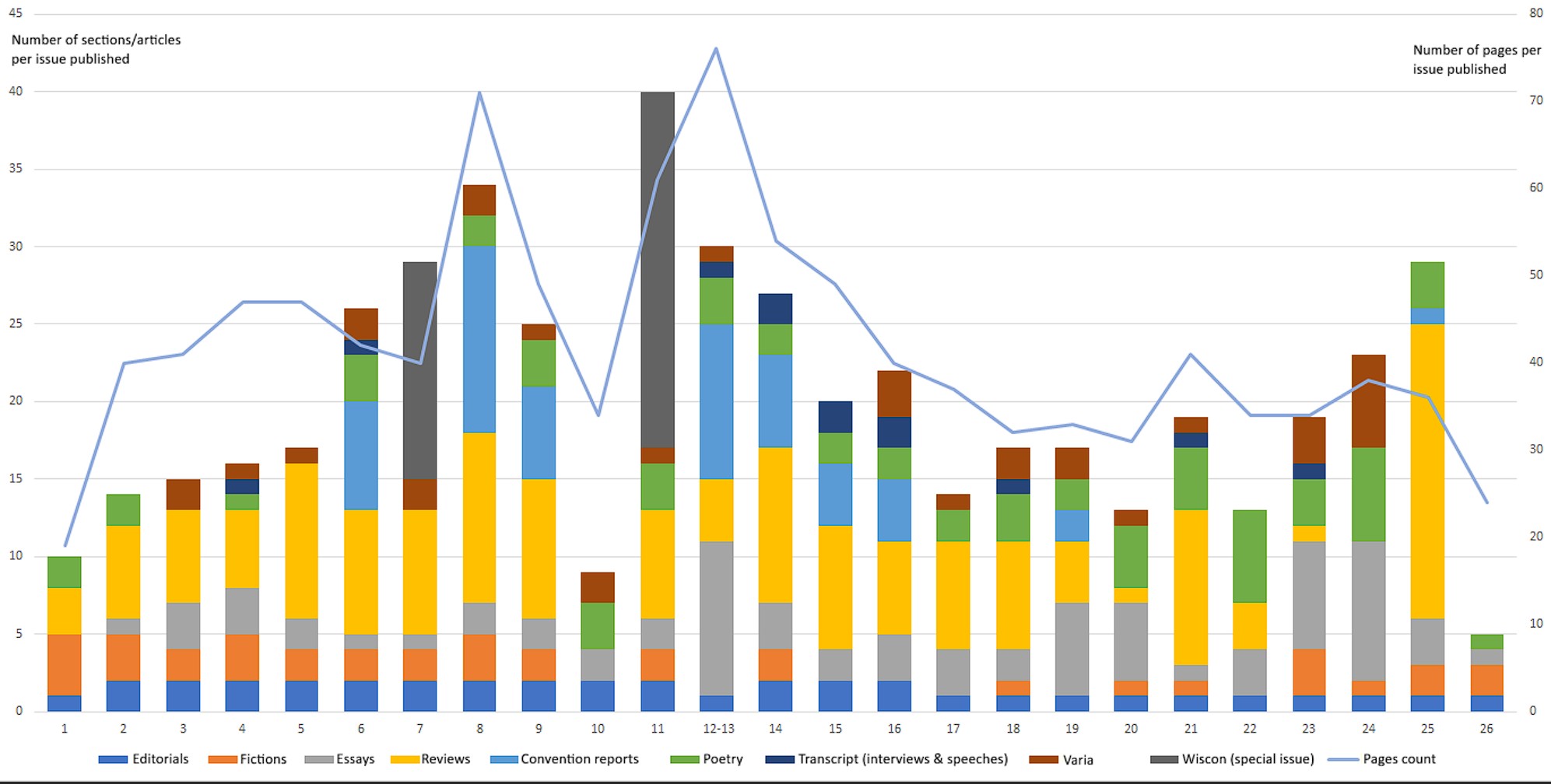
Figure 5. Composition of Janus and Aurora per issue (1975–1990) (columns of letters removed). Created by the author.
[4.4] These graphs inform us about the fanzines' editorial priorities. Figures 4 and 5 show the structure of a genzine attached to a local group, with a maximum print run of 500 copies (note 7). In interviews with editors, I noted contradictory intentions, some aiming to make the fanzine a place for fannish discussion, others for feminist publication, mirroring the model of poetry magazines or academic journals. The first graph shows a clear turn toward memory activism.
5. Epiphany narratives and fan canonization: How to build consensus on memories?
[5.1] Fan canonization is a central task in the construction of aesthetic reception to cultural products and serves to legitimize fan belonging in the SF community. However, it comes with a rewriting of their personal history in fandom. Some remember SF books as great feminist epics to the detriment of their political ambiguity. This selective memory can be explained by the importance certain novels have in connecting feminist and SF writing; asserting that one has always belonged to the other helps justify the intersecting space that is occupied by the fan. The narrative of feminist SF invention thus follows reading experiences; the mnemonic practices that make up the archive are part of this narrative.
[5.2] The fanzines to which I had access were collected by the WisCon and Corflu conventions (the latter being specialized in fanzines); some of them were accessible through the FANAC website, and others were sent by the fans themselves. These resources are complemented by the Fancyclopedia wiki and interviews on the Fanac: Fan History YouTube channel. During my research in 2022, I noticed the absence of several fanzines, notably those by Amanda Bankier and Janice Bogstad, who initially shared more literary views of feminist SF. In 1980, a rift arose between Bogstad and Gomoll, the coeditors of Janus, which led to an editorial break. The former published New Moon, which focused on literary analysis, while the latter, with the Madison group, created Aurora, which focused more on feminism in fandom. Logically, the fan archive favors the latter method: Gomoll, who shifted from editing to designing Aurora, remained involved in fandom. Unlike De Kosnik's (2016) polyvocality, fan archives—like all archives—report situated narratives created by the fans with the means and time to specialize in (fan) memory work. This reinforces dominant positions such as the emphasis on Big Name Fans' histories (e.g., Gomoll has a detailed Fancyclopedia page), even if that emphasis is relative to their microcosm.
[5.3] Talking about epiphanies, rather than a "moment of discovery" (De Kosnik 2016, 135), underlines the way fans' memories are shaped by the goals and values of fandom. In these discourses, fans identify writings that transformed their lives. These stories are entry-level resources that justify one's place as a fan and/or authentic feminist. Thus, both fans and researchers evoke the impact of their first encounter with SF while sharing their experiences. Jeanne Gomoll regularly refers to her first reading of Monique Wittig's Les Guérillères; in the fanzines, Jessica Amanda Salmonson (1981) speaks of Suzette Haden Elgin's At the Seventh Level as having impacted her because of the strong women characters; and Octavia E. Butler evokes Philip José Farmer's The Lovers as a work that contains such blatant misogyny that she was driven to write alternative stories (Bogstad 1978, 30). The purpose is not to question the integrity of their memory but to interrogate the content of their experiences, which presupposes a science-fictional reading skill (Saint-Gelais 1999) and an antimisogynist decoding. Such a presupposition is evident when a fan editor describes her first reading of The Left Hand of Darkness, explaining that she "credited Le Guin with a consciousness she may not have had." She read it as feminist work and neglected the homophobia therein, "making it the book I wanted to read" (Carol 1982).
[5.4] These stories contribute to the canon of SF fandom and impact the mainstream and academic canon. Not only can these canons coexist, but they also define each other reciprocally (the academic canon is, by definition, distinct from the mainstream and fan ones, even considered superior since academia has greater legitimizing power in mainstream settings). This does not mean that they are systematically opposed. Fans and academics (and sometimes academic fans) can participate in building an aesthetic autonomy—a self-referential corpus with its standards—for the feminist SF genre, using both fan and academic criteria and references. Moreover, feminist criticism was borne of women writers and fans who often occupied this dual position. However, it was not until the early 1980s that academic journal issues were devoted to these women researchers (Merrick 2009). Anthologies of women writers, such as Pamela Sargent's Women of Wonder, anthologies of critics, such as Marleen Barr's Future Females (1981) or Joanna Russ's logical analysis of the antifeminist trends in SF (Yaszek 2009), also played a key role in the construction of aesthetic autonomy and the affirmation of a double belonging to SF and (feminist) literary theory.
[5.5] That is not to say that fans are devoid of "instances of consecration" (Sapiro 2014, 86). Chronologically, the first ones are WisCon and "People's Programming." Susan Wood (1978) proposed the latter in a call in Janus to create feminist activities at mainstream conventions. The Madison group launched WisCon in 1977 (including Bogstad, Gomoll, and Martin, as well as Lesleigh Luttrell, Philip Kaveny) as a local feminist-oriented convention (note 8). This double strategy can be found in racialized and 2SLGBTQIA+ communities: a struggle to have their own spaces in general conventions (e.g., Carl Brandon Society) and the creation of their own forums (e.g., DiversiCon and GaylaxiCon) (Bacon-Smith 2000). These institutions function as sites for knowledge transmission and the development of collective fan memory. For example, the Tiptree Award was named after the male pseudonym—James Tiptree Jr.—of feminist writer Alice Bradley Sheldon—a prolific SF author at the end of the 1960s and during the 1970s whose name and gender were not known by the community before 1977 and who was famous for taking radical feminist stances such as in the novella "Houston, Houston, Do You Read" (1976). Created in 1991 during WisCon, the award was dedicated to "SF writings exploring gender-blending themes" in the context of a perceived rise of post-feminism (Murphy [1991] 1999). In 1995, books and writers from the 1970s retroactively received the Tiptree award, which affirmed the value of this collective memory, as well as the legitimacy and authenticity of feminist fans from that period.
6. Duty to remember and fan (her)story: the limitations of memory activism
[6.1] Fans inscribe their individual stories in the grand history of fandom, thus shaping collective memory. While discourses on the role of fanzines as a memory of fanesque events already existed (Luttrell 1977), these activities took on a central role following the reorganization of the Janus fanzine's editorial board, which became Aurora in 1980, with a new focus on memory work and biographies of marginalized female authors.
[6.2] During the 1980s, fans engaged in countermemory or herstory work in a context of conservative reactivity. An entire issue of the fanzine Aurora (1984, vol 9, no 1) was devoted to the memory of women writers. It included essays on Katherine MacLean, Charlotte Perkins Gilman, and nineteenth-century female fantasy writers. At the same period, scholars increasingly drew from the feminist SF corpus—while aiming to deconstruct gender binarism and androcentric narratives (Larue 2018). These critiques distanced themselves from the fandom canon they considered essentialist—even if the feminist fans saw their genre less as a glorification of women's works than a memory site preserving women's accomplishments in SF fandom. L. Timmel Duchamp (2004) reproached Marleen Barr for her attempt to replace the term "feminist SF" with the broader "feminist fabulations." Such a shift in terminology would have been tantamount to "a sentence of exile from the only place where [feminist writers' and fans'] work is likely to be welcome" (17). The situation remains intricate, as these individuals often occupy overlapping spaces: the SF fandom, the academic study of feminist literature, and counterculture. For example, writers Russ and Samuel Delany participated in these theoretical endeavors while remaining invested in fandom; Bogstad arose from fandom; and Barr had already contributed to fanzines. This complexity resulted in mutually constitutive and sometimes contradictory memories between the two different spaces—fandom and academia—as the discourses and even identities coexist within the same individuals.
[6.3] The special issue of the fanzine Khatru, edited by Jeffrey D. Smith, "Women in Science Fiction," appeared in 1975. It is an exchange of letters between female writers Chelsea Quinn Yarbro, Joanna Russ, Ursula K. Le Guin, Vonda McIntyre, and Suzy McKee Charnas, among others, on the theme of women in SF. Their letters criticize the presence of men in a discussion about feminism and offer theoretical essays (on patriarchy by Charnas and sexual dimorphism by Tiptree). During the interviews, fans admitted they had not read Khatru when it was published. Nonetheless, it acquired classic status in feminist fandom, and the Madison group republished it in 1993 with retrospective comments by female writers and the addition of reflections by fans. From their perspective, the republication of Khatru was an act of reflexivity and a "re-claiming of [our] history" (Jane Hawkins quoted in Smith and Gomoll 2009, 118). The fanzine became a place where the boundaries between fans and writers, history and memory, were blurred, where the reconsideration of the writers' work served to celebrate the fans of the same era and their role in the construction of feminist SF.
7. Memory of activism: Generational break and the inertia of past narratives
[7.1] Collective memory, as expressed in fan narratives, always restructures itself. Traces of past struggles and visions of SF, of its fans, of their genre and beliefs can be found in present-day narratives. Feminist narratives are challenged by fans who defend an apolitical community and by other feminists who contest the inclusiveness of these memories.
[7.2] My first experience with North American feminist fandom was when I read Jeanne Gomoll's Open Letter, published in 1986 in the fanzine Aurora. In that letter, she criticized introductions written by Bruce Sterling to cyberpunk anthologies that dismissed the 1970s as a bleak period of "Mother Earth" SF. Gomoll (1986) argued his dismissal was tantamount to locking women writers into an irrelevant past. She parallels his discussion of feminist SF during the 1970s as a "a self-involved, 'me-decade', [wherein] nothing worthwhile was created" with strategies used to dismiss "the women's movement as a whole" (8). This amnesia affects fans too: "I'm always amazed at how unrepresentative the memories of the panelists [at round-table discussions 'Retrospective on 70s fandom'] […] Fandom is supposed to be cemented together by tradition and memories held in trust and passed down to future fannish generations" (7). The narrative around the invention of feminist SF as a space for experimentation appears to contradict the cyberpunk narrative, as a return to technology. Fans such as Avedon Carol claim that feminist SF writers anticipated cyberpunk. She and Joanna Russ denounce "the rewriting of history by the 'gatekeepers of culture'" apparent in the forgetting of the influences of women writers such as Alice Bradley Sheldon in this new subgenre. Author Suzy McKee Charnas sees it as "an expression of Backlash" (note 9). While memory activism already existed, the survival of the memory of this feminist SF became imperative to cement the presence of feminist writers and fans in SF. Gomoll's letter was reprinted many times, and its narrative spread. The French books that draw on their content (e.g., Ïan Larue's Libère-toi cyborg!) treat feminist fandom as a monolithic and homogenous group with a single narrative.
[7.3] Feminist fandoms can be compared to "abeyance structures": activist networks that subsist during periods of backlash, maintaining repertoires of goals and an activist culture (Taylor 1989). The collective memory of fans is a similar mechanism: it refers to socially and historically situated militant identities and activist goals, and it reiterates the exclusions specific to the time of their inscription. Nancy Whittier studied generation changes in the context of radical feminist social movements: new cohorts bring new values and attitudes, but they also "redefine [the movement's] collective identity" (2010, 256). This replacement affects the transmission process ensured by the collective memory. In WisCon, a generational divide became salient during a debate around the Tiptree Awards, a symbol of memory activism, about Tiptree's planned suicide alongside her then-incapacitated companion. The award was renamed Otherwise, putting aside Tiptree's name associated with a specific period of feminist SF writings as well as discussions around disability and ableism. Her name evokes memories of what has been called the second wave of feminism, describing a set of practices and identities attached to a specific period that can be emotionally charged for fans who fought for this memory (Hemmings 2005). However, it also raises questions about the place of other marginalized groups within the fandoms who were excluded in this era or, at least, from the memory of this era (i.e., racialized fans, 2SLGBTQIA+ fans, fans living with disabilities, etc.) (Plutchak 2017). Fans from excluded and oppressed marginalized groups have always been present; however, their collective memory has not been well preserved in mainstream spaces due to a lack of access to archives and technologies of inscription, including feminist SF narratives dominated by white, cisgender, able-bodied women whose collective memory, while radical in its own right, omits and excludes the experiences of those who are less privileged.
8. Conclusion
[8.1] At the start of the article, I asked what makes SF fans and feminist practices converge and what power dynamics are at play. The first hypothesis was that collective memory, which is known to be a driving force in feminist mobilizations, is also one of the places where feminist and fan practices converge. I found that memory activism was at play in the common fan practices before the backlash and subsequent turn to memory. I used the concept of symbolic autonomy to show that memory work is an essential component to sustain the grand conversation, to produce consensus on the corpus and fandom stakes, to homogenize narrative patterns, and to display belonging to the community. In other words, it contributes to installing self-referentiality: the community's ability to establish its evaluation criteria to support its call for a more representative literature, sensitive to feminist concerns, acknowledging the enduring presence of fans in both worlds of feminism and SF. This way, I argued that fans have a role in the construction of the feminist SF subgenre.
[8.2] The second hypothesis drew on De Kosnik's (2016) arguments; the memory and memorial activism of feminist SF fans tend to converge with queer subcultures, while continuing to be exclusionary—for example, invisibilization of marginalized groups because of an emotional attachment to an ostensible golden age of activism situated in the 1970s. Such a study of power dynamics at play in fan-history practices—especially the questions of authoritative memories and interpretations—is not fundamentally new. My goal was to show a way to grasp those dynamics: how fans preserve their collective memory and how those narratives carry political projects, with their inherent exclusion.
[8.3] The importation of North American feminist narratives into the French fandom and the selective availability of archives are the product of fan memory activism and not mere preservation. Far from proliferating freely, interpretations of feminist narratives and archiving practices are shaped by the social frameworks of memory. Individual contributions to the collective memory are "likely to be governed by the existing hierarchies and inequalities within fandom, compounded by race-based boundary policing and class-dependent access to leisure time and capital" (Stevens and Webber 2022). For the researcher, this implies both an intersectional stance, which "draws attention to the epistemological frames that enable or erase recognition of harm" (Chidgey 2023, 66), and a "strategic presentism" (Fendler 2008) as a means of linking the past to the present, emphasizing discontinuities, reporting multiple and competing interpretations situated in the present and in the past. Against a univocal memory, I focused on the struggle for the possession of this memory, to emphasize polyvocalities and restrictions (Olick and Robbins 1998).
9. Acknowledgments
[9.1] This paper came from MSc research supervised by Emmanuel Taïeb (IEP Lyon) and Hélène Breda (LabSIC). It was first discussed in Marie-Josée Massicotte's seminar and translated with the help of Gauvain Roussel-Tarbouriech (CEA-List). Many people helped translate and revise, notably Calla Barnett (uOttawa), Bruce McKenna (UQAM), Étienne Goron (Science Po Paris), Joseph Gubbels and Karandeep Singh (uOttawa), and Joachim Boaz. I would also like to express my gratitude to the reviewers and TWC editors for their thorough reading and their patience.