1. Introduction
[1.1] In 2020, Suzanne R. Black observed that digital methods "seem well-suited to the study of fan fiction" (¶ 2.2). Since then, developments in digitally oriented fields like computational literary studies (CLS) and natural language processing (NLP) have only sped up, and the relatively recent introduction of large language models for the analysis of, among other things, textual data, has accelerated these developments further. The born-digital nature of fan works like fan fiction makes the material fitting for digital methods, and the incredibly large scale of fan fiction datasets—AO3, to name a well-known example, currently hosts over 15 million works—is well suited to approaches, like distant reading, where scale is an asset. I apply methods from natural language processing, specifically, the NLP-pipeline Riveter (Antoniak et al. 2023), for assessing the dynamics of power and agency between textual entities, with fan fiction as a test case to assess the affordances and limitations of this pipeline for text analysis. I argue that Riveter provides important functionalities for gaining insight into the operations of power and agency in large sets of narrative texts, particularly because of its transparency and its capacity to take both semantics and grammatical structure into account. At the same time, comparing the Riveter analysis with a close reading indicates that the more metaphorical and figurative dimensions of language use that characterize the representation of agency and power in fan fiction are not detected.
[1.2] As a case study for testing Riveter, I examine how fan fiction about Greek mythology represents the relationship between Hades, god of the Underworld, and Persephone, daughter of the goddess Demeter. In many versions of the Hades/Persephone myth, such as the Hymn to Demeter (Anonymous 1914) and the Metamorphoses (Ovid 2010), their relationship is characterized by Persephone's disenfranchisement. As Piper Hays notes: "It's been a story of rape and captivity for thousands of years" (2023). In many versions of the myth, Persephone is abducted, imprisoned (often through trickery), and raped by Hades. In some versions, Persephone is trapped in the Underworld after her initial abduction because she eats some of the food that grows there, forever binding her to the place. In other versions, Demeter is distraught by her daughter's abduction and asks Zeus for help. Zeus decides that Persephone must spend half of each year on earth with her mother and the other half in the Underworld with Hades. Persephone herself has nothing to say on the matter. Both versions of the story have a clear power dynamic in which Hades has power, autonomy, and agency, and Persephone has none of these things. This clear-cut gendered power differential in what could be called the myth's normative and dominant versions makes it an interesting case study for testing out Riveter's capacity to measure how these characters' power and agency are represented in fan fiction.
[1.3] Previous analysis of a larger corpus (over 5,000 works) of fan fiction about Greek myth on popular fan fiction website Archive of Our Own (AO3) shows that Hades and Persephone are the two most frequently occurring characters in fan fiction for the Greek mythology fandom, with Hades occurring 488 times and Persephone occurring 442 times in that dataset (https://doi.org/10.34973/2MYE-8468); Neugarten 2024). The popularity of these characters suggests that they appeal to contemporary fans of Greek mythology, which makes the dynamic between them relevant to understanding wider trends and patterns in Greek myth fandom as well.
[1.4] My primary aim is to test the usefulness of Riveter for assessing gendered dynamics of power and agency in fan fiction. Any thorough evaluation of Riveter as a tool requires a case study to test it on, and any content-level analysis of data requires some reflection on how the used tool fits that data. In what follows, I reflect first on the way I (computationally) operationalize gender, a key concept in the analysis of gendered power dynamics. I then report on the process of data collection and outline how Riveter works and what it can and cannot do. I then dive into the case study in more detail, reporting on Riveter scores for the characters of Hades and Persephone and for gendered dynamics of power and agency for characters in the dataset overall. I evaluate Riveter's performance through comparisons to a (much) smaller dataset—a single story—I annotated manually. I close-read this story and discuss some of the dimensions of gendered power and agency, as these concepts are textually represented, that Riveter cannot detect. Finally, I discuss my findings and some avenues for future work and present my conclusion on Riveter's usefulness for analyzing fan fiction.
2. Computational approaches to gendered power dynamics
[2.1] In computational literary studies (CLS), the dynamics between fictional characters of different genders has been studied in various ways. Underwood et al. (2018) found that in English-language fiction, "gender divisions between characters have become less sharply marked over the last 170 years" (1). In contrast, Smeets (2023) found that the words used to describe male and female characters in Dutch literary fiction remained stereotypical when comparing a corpus of literature from the 1960s to novels published in 2013. Similarly, in a corpus of contemporary English-language fiction, Kraicer and Piper (2019) find that "when we look at how women are characterized…we find familiar patterns of marginalization" (2). In other words, scholarship on gendered power dynamics in mainstream published fiction is mixed, with some research pointing to a decrease in inequality or stereotyping between fictional characters and other research pointing to the persistence of gendered inequality in fiction.
[2.2] Because it is often simplified into a binary variable, gender is considered relatively straightforward for scholars working in CLS to analyze. This binary approach oversimplifies the complex way gender exists in reality, although this oversimplification can perhaps be defensible in some cases. The entire field of CLS is, by necessity rather than choice, confined to using proxies to analyze their data (Piper 2017). Nonetheless, an oversimplified operationalization of gender seems especially ill-conceived when it is used to analyze fan fiction, since fan fiction often portrays characters with a diverse array of gender identities. Within the scope of the current paper, I have no perfect way of addressing the problems that arise when gender is oversimplified into a binary variable. Although Riveter looks at instances of they/them as well as he/him and she/her when detecting entities, the software may fail to detect instances where a character's pronouns shift over the course of a story. This is something to keep in mind when analyzing results. However, the metadata for the dataset includes additional tags defined by the fan work's authors, and tags referring to gender identities outside the binary were very rare (note 1). When used, these tags were never explicitly linked to Hades or Persephone. This suggests that the number of characters that Riveter overlooks because their gender identity is not male or female is small.
3. Dataset
[3.1] To test our Riveter for the analysis of fan fiction I use a corpus of 745 stories (around 1.4 million words in total) in English from AO3. At the time of corpus collection (December 2022), all works were in the Ancient Greek Religion and Lore fandom (AGRL). Stories were selected for the presence of at least one of the following tags, used to identify the Hades/Persephone relationship: Hades/Persephone (Kore); hades / persephone; Hades/ Persephone; Persephone/Hades; Persephone/Hades (Hymn to Demeter - Homer). I selected these tags because they refer to a romantic or sexual Hades/Persephone relationship.
[3.2] The dataset contained stories tagged with 175 different fandoms. Tags denoting Hades/Persephone relationships that were explicitly associated with other fandoms, such as Lore Olympus, Percy Jackson, or Hadestown, also occur in the dataset when they are used in combination with the tags listed above, though not when they are used without these other tags, or without the AGRL fandom tag. The overlapping of these tags raises a variety of interesting questions for fan studies regarding the (in)stability of fictional and mythological characters across historical periods, adaptations, media, and storyworlds. Stories tagged with other fandoms besides AGRL may be transforming different or more diverse cultural norms and discourses than the patriarchal norm of Greek mythology. However, tagging practices on AO3 are usually meticulous and accurate (Price 2019) so I consider the AGRL tag a reliable indicator of a relationship between the tradition of Greek mythology and the fan fiction in the corpus.
[3.3] The dataset contains only stories that are longer than zero words and shorter than 10,000 words. That constitutes approximately 88 percent of all stories tagged with the relevant tags available on AO3 at the time of data collection. Stories longer than 10,000 words were disregarded, because one of the most important tasks Riveter performs is coreference resolution: finding and linking linguistic expressions in a text that refer to the same entity. Research has shown that "co-reference resolution performance deteriorates quickly with longer (novel sized) text, causing too many co-references to different characters to be conflated" (Van Zundert et al. 2023, 767). In other words, coreference resolution becomes increasingly error-prone as text length increases. To mitigate this problem, I examine only stories shorter than 10,000 words, although of course this length limitation in itself may be considered one of Riveter's most important drawbacks for the analysis of fan fiction.
[3.4] The dataset was collected using the AO3Scraper (https://github.com/radiolarian/AO3Scraper). The total size of the resulting dataset is 1,474,805 words for 745 stories, with an average word count per story of 1,979.6 words, a median word count of 1,240 words, and a standard deviation of 2,056 words. The shortest story was sixteen words and the longest was 9,741 words. Stories in the dataset were split into chunks before being fed into the Riveter pipeline. The resulting 46,174 chunks were separated according to line breaks, so some chunks contain single lines of dialogue while others are descriptive paragraphs. Chunks were sequentially connected to the stories they belonged to by a unique ID that consisted of a work-ID and a number, so subsequent chunks from the same story were labeled story-ID-1, story-ID-2, story-ID-3, and so on.
4. Method
[4.1] Riveter is software "for analyzing verb connotations associated with entities in text corpora" (Antoniak et al. 2023, 377). In a special section about artificial intelligence, it seems appropriate to contextualize Riveter and the way it functions within the wider fields of AI and machine learning. Riveter is a natural language processing (NLP) pipeline. NLP, the branch of computer science that deals with machine learning for understanding human language, often but not always uses artificial intelligence. NLP pipelines can perform tasks that typically require human intelligence, such as recognizing entities in a text (named entity recognition or NER), and the task of coreference resolution described above. To perform these tasks, Riveter employs components that rely on machine learning, such as neural networks in NeuralCoref (https://github.com/huggingface/neuralcoref) for coreference. However, the way Riveter calculates power and agency scores is not machine learning; the software is calculating scores based on a lexicon but not developing or refining an operationalization of the concepts of power and agency as it runs. In other words, when calculating and assigning power and agency scores, Riveter is not learning.
[4.2] It is possible that a large language model like GPT-4 would perform better at the tasks of detecting power dynamics and character agency in fan fiction. Research has shown that such models do well at tasks like sentiment analysis (Rebora et al. 2023) and sentiment classification (Borst et al. 2023) for literary text. However, the advantage of a lexicon-based tool like Riveter over large language models is its transparency and explainability. Using Riveter, you can see exactly which words contributed to which scores, which makes the pipeline's outputs easy to assess and evaluate.
[4.3] To measure levels of agency and power associated with each entity in the texts, Riveter uses lexicons. These lexicons rely on the assumption that language portrays or frames different entities in a text, including but not limited to characters, in different ways that reveal something about their power and agency in the fictional world. As Sap. et al., the creators the power and agency lexicons employed by Riveter, put it: "The framing of an action influences how we perceive its actor" (2017, 2329). By analyzing these frames on a large scale, we can gain insight into larger societal patterns of bias and dominant ideology as they are portrayed in the corpus. NLP offers several tools for analyzing such framing in narrative text, and Riveter combines some of those into a pipeline, or a sequence of data processing modules, where the output for one step provides the input for the next.
[4.4] The Riveter pipeline consists of four components: Document parsing; People and entity clustering (named entity recognition and coreference resolution); Agent-Verb-Theme triple extraction (dependency parsing); and Lexicon matching, using one of two possible lexicons. First, the pipeline parses the input documents for their grammatical structure. Second, it identifies entities using named entity recognition (NER) with SpaCy (https://doi.org/10.5281/ZENODO.1212303) and conducts coreference resolution, linking together linguistic expressions that refer to the same entity. Third, Riveter identifies verbs and parses the dependencies of objects and subjects for those verbs, creating Agent-Verb-Theme triples. In the final step, these triples are matched against connotation frames from one of two sets of lexicons: Rashkin et al.'s (2016) lexicons of connotation frames related to agents' value, sentiment, and effect, and Sap et al.'s (2017) lexicons of connotation frames related to power and agency.
[4.5] I use the two lexicons created by Sap et al. (2017) included in Riveter to operationalize power and agency. The power lexicon contains verbs that "imply the authority levels of the agent and theme relative to one another" (Sap et al. 2017, 2330). Power is thus operationalized as relational in this lexicon: Entities always experience an increase or decrease of power relative to other entities. For agency, Sap et al. explain that "agency attributed to the agent of the verb denotes whether the action being described implies that the agent is powerful, decisive, and capable of pushing forward their own storyline" (2330). Agency, then, arises out of an agent's capacity to exert control over their circumstances. Some examples of verbs indicative of a certain dynamic of power or agency—taken from Sap et al.—are as follows: "need" or "dread" increases the power of the theme but decreases that of the agent, while "defeat" or "educate" increases the power of the agent while decreasing the power of the theme. To "sleep" or to "wait" lowers an entity's agency, while to "manage" or to "fight" increases it.
[4.6] This method has limitations. At each of the four steps in the pipeline, things can go wrong. Errors in parsing the grammatical structure can seep down and cause errors in the entity recognition, coreference resolution, and triple extraction, so that entities may be missed, incorrectly identified, or not matched with the appropriate entry in the lexicon. Additionally, any method of corpus analysis that uses a lexicon to operationalize variables—in this case the complex concepts of power and agency—is only as accurate as the contents of its lexicon. While Riveter is more advanced than dictionary-based corpus analysis methods like Linguistic Inquiry and Wordcount (Pennebaker et al. 2015) because it takes grammatical structure into account, inaccurate results may still arise from types of meaning, like slang, irony, or polysemy, that the lexicons fail to capture. Antoniak et al. observe that "lexica that are useful in one setting are not always useful in other settings" (2023, 384). Additionally, research has shown that the discursive norms of fan fiction communities can sometimes differ markedly from language use in other domains, particularly when it comes to describing emotion (Neugarten 2023). This makes it more difficult to capture the meaning of fan data using dictionary- or lexicon-based methods. I thus investigate to what extent Riveter can be usefully applied to fan fiction data.
[4.7] A final caveat: Entities have a somewhat more complex nature in a corpus of fan fiction than in many other types of textual data. It is debatable whether Persephone is the same character in a work of fan fiction heavily inspired by the Hymn to Demeter as she is in a fic based on Lore Olympus, a popular contemporary webcomic and graphic novel (Smythe 2021). At the same time, writers in the AGRL fandom are likely also reading other stories in that fandom, and so different iterations of a character may influence each other. As noted above, this overlapping of different characterizations with their roots in different source texts is impossible to trace exactly with Riveter, as the software is likely to label all mentions of "Persephone" as the same entity. Since intertextual influences and divergent characterizations occur in fan fiction in other fandoms and even some literary texts as well, this is also a limitation of the tool to keep in mind.
5. Results
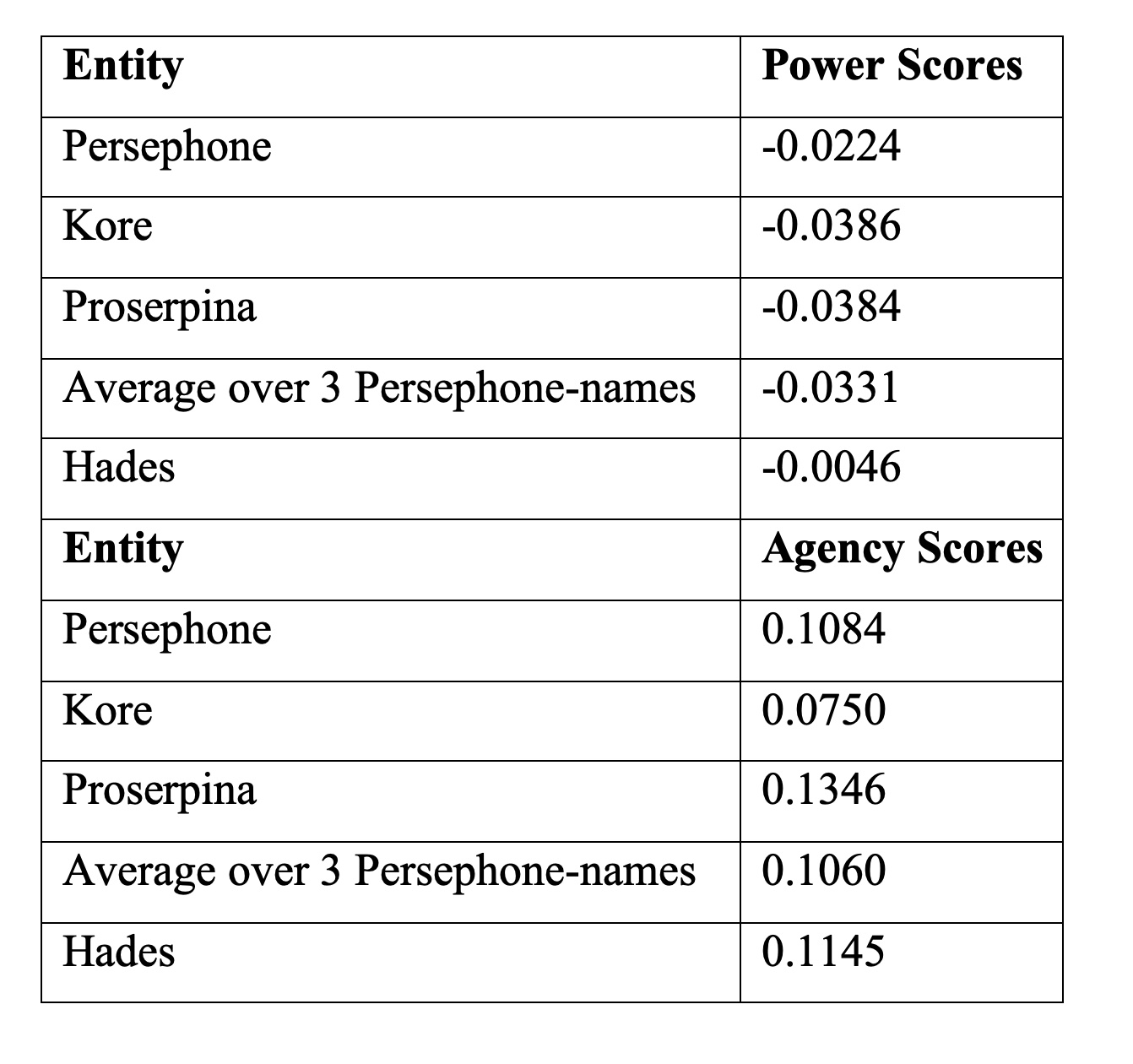
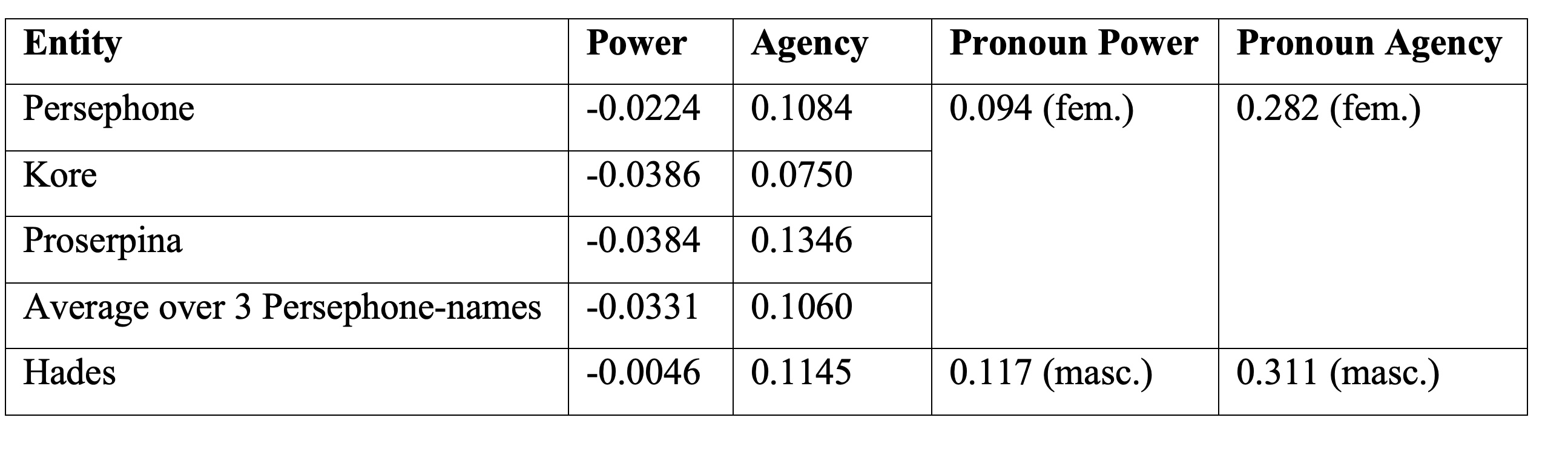
[5.1] The case study I use to test Riveter revolves around the gendered power dynamics and distribution of agency between the characters of Hades and Persephone in fan fiction about Greek myth. The first step in mapping these dynamics is to compare scores for the entities "Hades" and "Persephone" as identified by the tool. Riveter associated 4,731 mentions with an entity labeled "Persephone," as well as 706 with "Kore" and 47 with "Proserpina," two other names often used for Persephone. Proserpina is her Latin name, and Kore, which means maiden, is one of her most persistent nicknames. Riveter associated 4,675 mentions with the entity "Hades." Riveter calculates persona scores by adding and subtracting the total of scores assigned to a specific entity or persona by the selected lexicon. Table 1 lists the power and agency scores assigned to Hades and to Persephone under her various names. All four entities have negative power scores, although the scores for Kore, Proserpina and Persephone are much lower than for Hades. Relatively, then, Hades is more powerful than Persephone, regardless of which of her pseudonyms is used.
Table 1. Power and agency scores for Hades and Persephone entities.
[5.2] Riveter also facilitates a more fine-grained analysis of these results. Figure 1 illustrates the verbs that contributed to the power score for each entity. These visualizations are intuitive to interpret. The entities are listed at the top (from left to right: Persephone, Kore, Proserpina, Hades). Verbs with a green square contribute positively to an entity's power score, pink squares contribute negatively, and the brighter a square's color is, the greater its contribution to a score. The grammatical relationship between the entity and the verb (direct object or nominal subject) is specified in each case. These figures also give some insight into how Riveter's lexicons work. For example, "asking" lowers an entity's power score while "knowing" increases it. Persephone does more "knowing" (93) than her alter egos Kore (6) and Proserpina (1), but less than Hades (102). The verbs contributing to the power scores for both entities overlap somewhat: Both Hades and Persephone are frequently made more powerful by "know" and "pull" and less powerful by "kiss", "hold," and "ask". These verb frequencies should be interpreted in light of the absolute frequency of occurrence for each entity (table 2); Persephone scores higher in absolute terms than Kore and Proserpina for (almost) every verb because she occurs more in the dataset. Overall, the differences between Hades and Persephone for most verb scores are small.
Table 2. Absolute frequency of occurrence for mentions in an entity cluster.
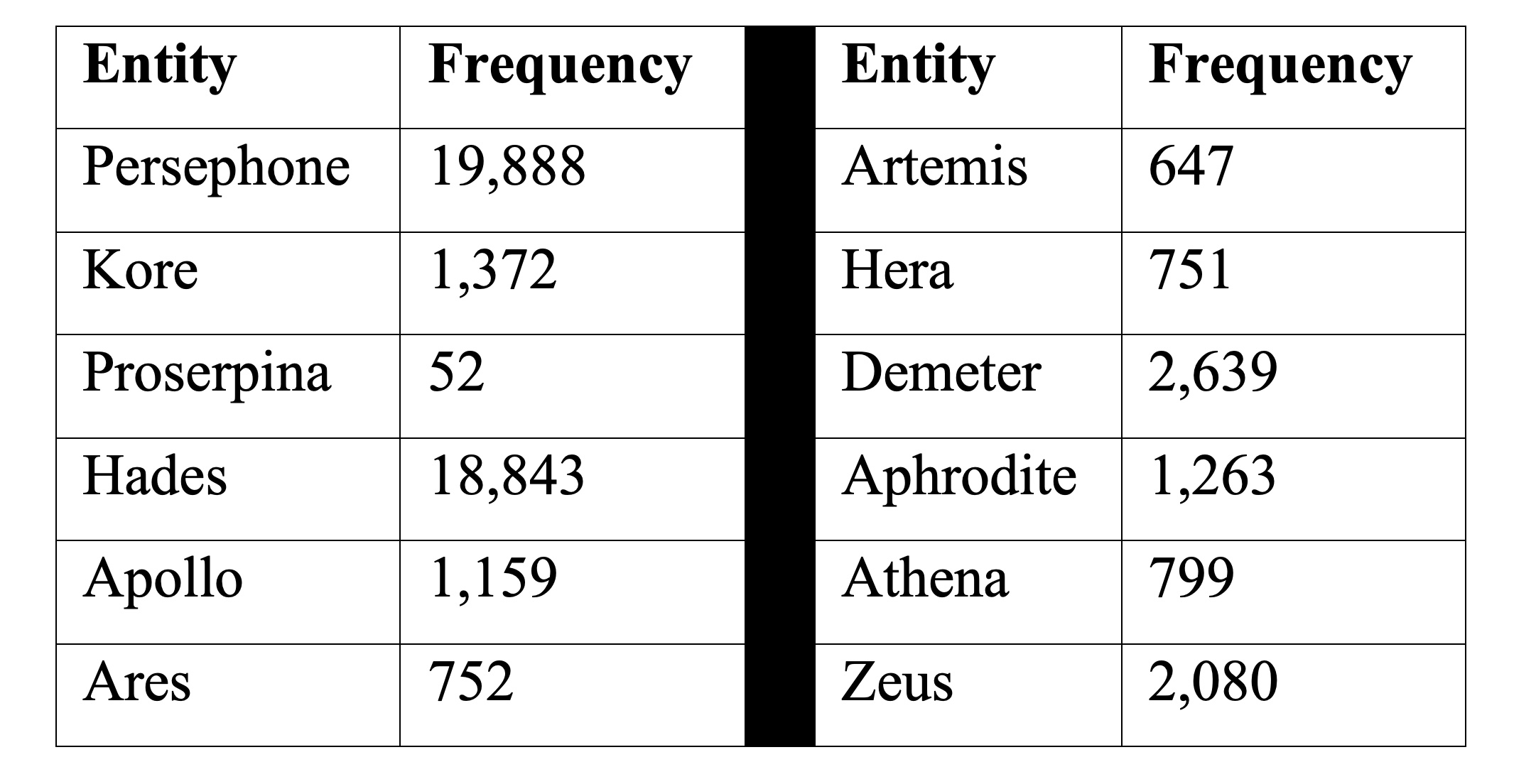
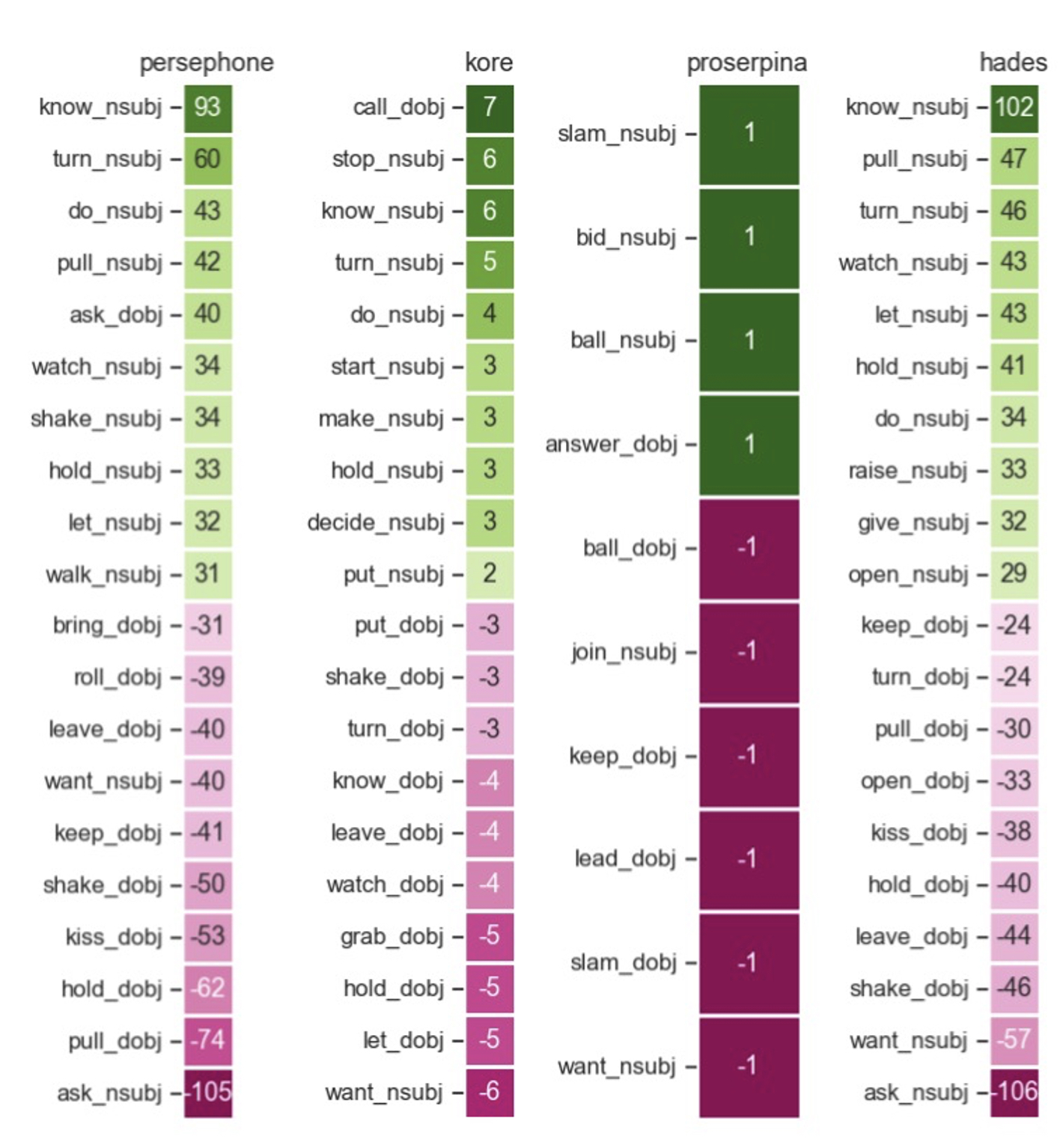
Figure 1. Verbs contributing to power-scores per entity, created by the author using Riveter on May 29, 2024.
[5.3] For agency, Riveter assigned positive scores to Persephone, Proserpina, and Kore (table 1). Persephone has lower agency under the name Kore than under her other names. Especially given the name's etymology, this could indicate that it is more commonly used to refer to the character when she is still relatively young and perhaps dependent on others. Hades also has a positive agency-score, which is higher than "Kore" and "Persephone" but lower than "Proserpina." Again, the verbs that contributed to these agency-scores were visualized in Riveter (figure 2), and again, results show a lot of overlap. Both Hades and Persephone gain agency with the verbs "say," "ask," "think," and "take" and lose agency with "see," "want," "sit," and "know." Because the verbs contributing to the Riveter scores are similar for both characters, they do not allow us to detect many differences in the ways these characters gain, lose, assert, or cede power or agency in the stories.
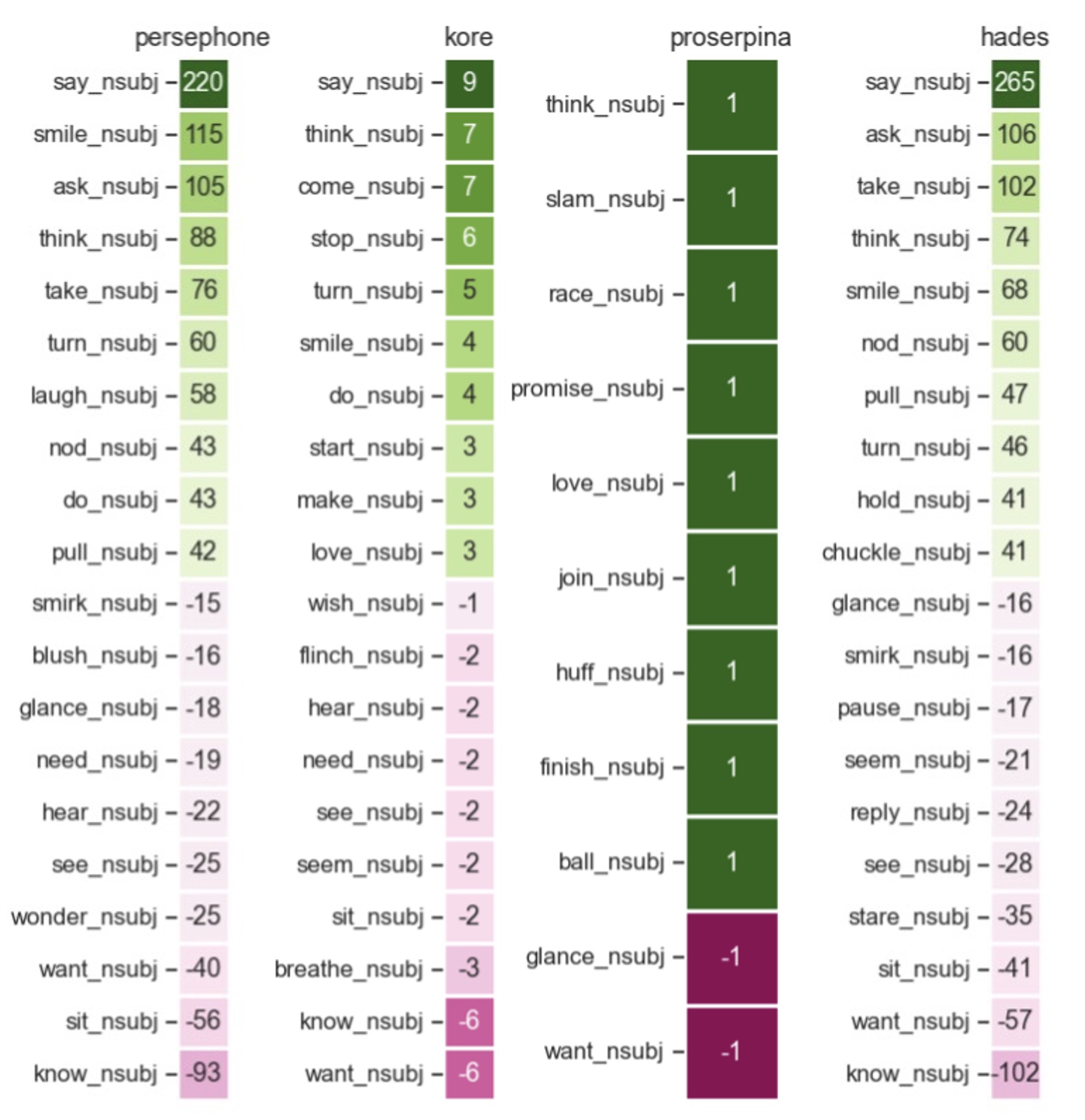
Figure 2. Verbs contributing to agency scores per entity, created by the author using Riveter on May 29, 2024.
[5.4] Nonetheless, examining the verbs that contribute to the characters' agency scores reveals one interesting difference between Hades and Persephone, which may point to gendered framing of the characters. Persephone smiles 115 times, plus four times under her alter ego Kore, while Hades smiles only 68 times in total. Riveter counts "smile" as contributing to a positive agency score; the verb is likely to communicate that a character is pleased, which in turn may relate to a sense of self-reliance or independence that can indicate agency. However, it is also possible to interpret smiling as an act of deference, in which case it would be erroneous to see it as an indicator of agency. Smiling, then, is an action that derives its agency from the context in which it occurs. A quick look at instances of the word "smile" in the corpus, however, indicates that the verb is mostly used when characters are happy, rather than when they are trying to seem unthreatening or deferential to others.
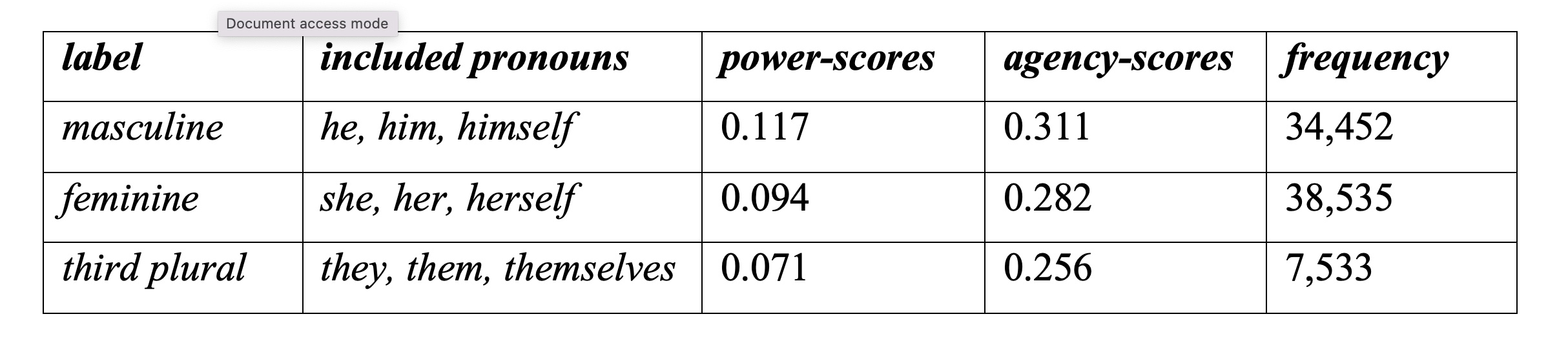
[5.5] Riveter can also capture and aggregate agency and power scores for all entities referred to by the same set of pronouns (table 3). These pronoun models then give insight into the power dynamics between, and agency of, all entities referred to by those pronouns, grouped together. When examining these pronouns in the aggregate, both sets of scores—for power and agency—reflect gendered inequality: men hold more power than women, and Riveter also assigns male entities a higher agency score than it does people referred to with other pronouns. This is in line with existing scholarship, where Sap et al.'s agency lexicon was applied to modern films and high-agency women were also rare (2017). Pronouns in the third person plural can refer to both groups and individuals who use they/them pronouns, so it is difficult to determine what scores for this pronoun-group convey. However, in a small sample of one hundred stories categorized by Riveter as having third-person plural pronouns, all instances of these pronouns referred to plurals (multiple people or things).
Table 3. Pronoun scores.
[5.6] The verbs that contribute to Riveter's scoring of the pronoun groups (figures 3 and 4) indicate the romantic content of much fan fiction in the corpus: there is lots of "wanting" (533 for her, 405 for him, 44 for them), "needing" (156 for her, 179 for him, 47 for them), and "reaching" (162 for her, 169 for him, 51 for them) going on for all genders, and being "kissed" (175 for her, 162 for him, 0 for them). The fact that "kiss" is used zero times for they/them pronouns further indicates that these pronouns almost exclusively refer to plural entities rather than nonbinary people, since it is unlikely that a group of multiple people would be the direct object of a kiss. People are often "pulled" (176 for her, 114 for him, 26 for them). Women are much more often "held" (117) than men (0) or plurals (27). Women more often "know" something (791), compared to men (647) and plurals (114). On the other hand, men more often "do" something (544), compared to women (472) and plurals (147). Men and women are on equal footing when it comes to "making" (268 for her, 263 for him), although plurals lag behind here with 82.
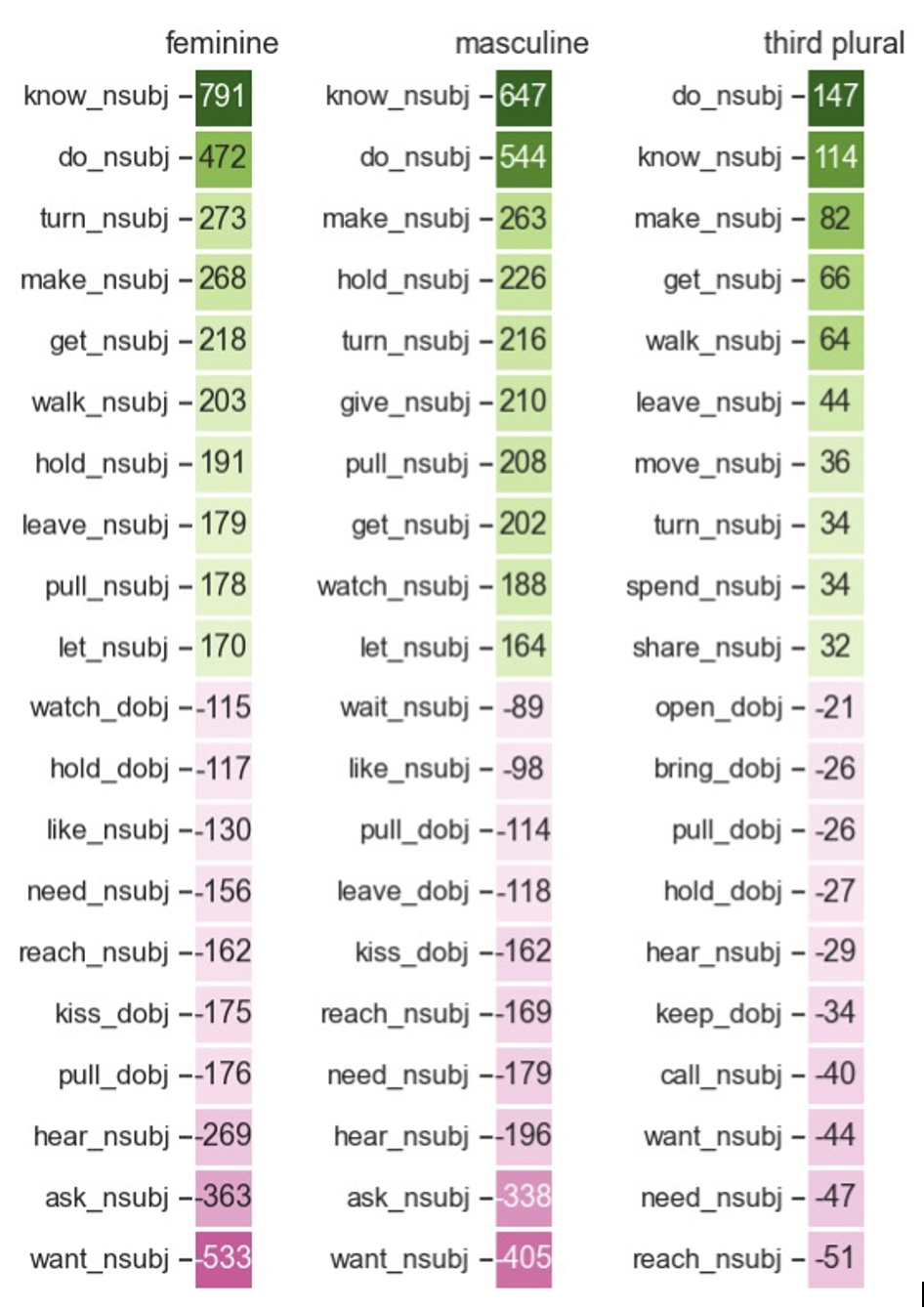
Figure 3. Verbs contributing to power scores for each pronoun group, created by the author using Riveter on May 29, 2024.
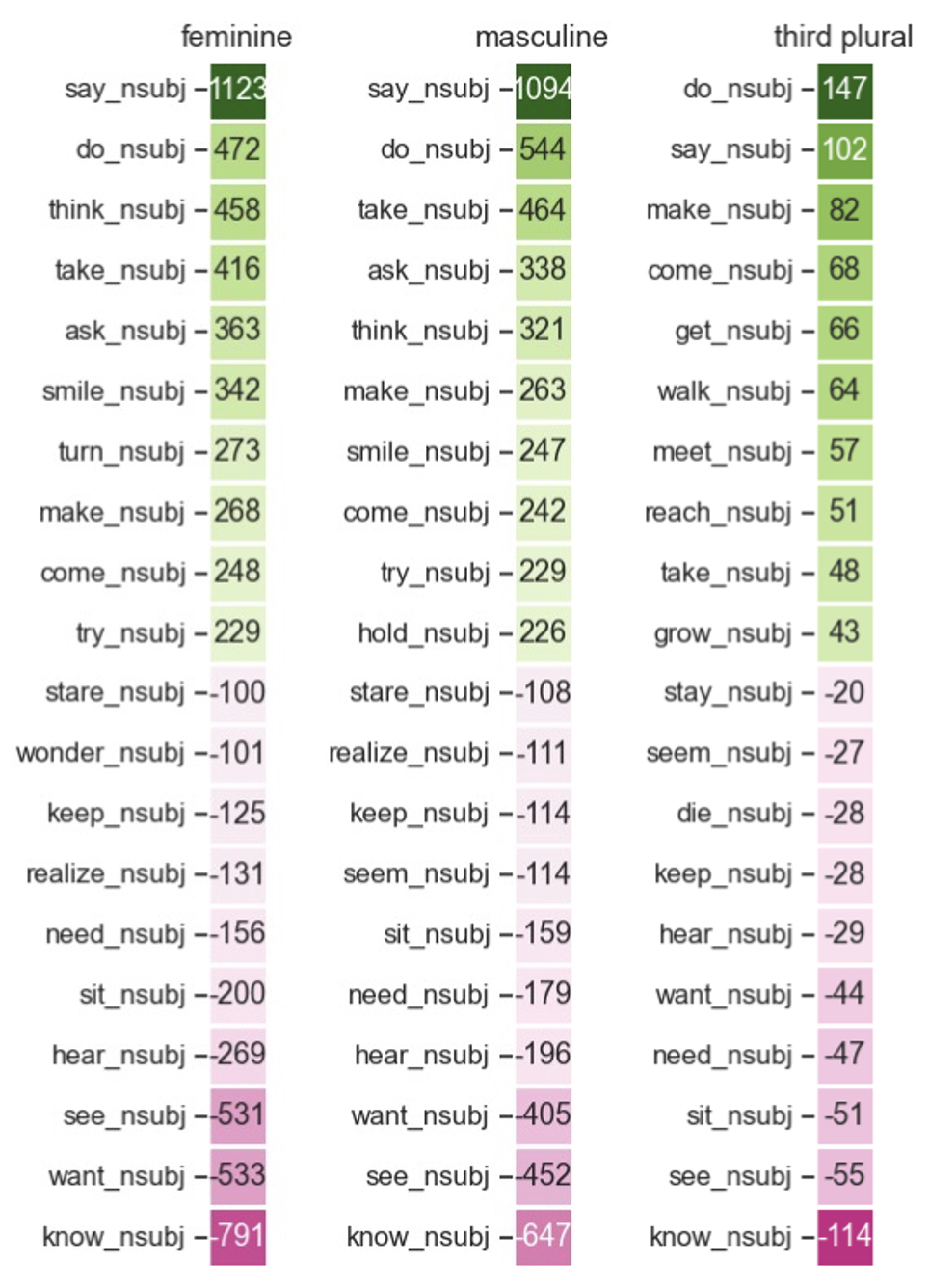
Figure 4. Verbs contributing to agency scores for each pronoun group, created by the author using Riveter on May 29, 2024.
[5.7] Finally, the scores and analysis of gendered pronoun groups can be considered a kind of baseline to answer one more fine-grained question of our case study: Are Hades and Persephone portrayed as more or less agentive and powerful than the average entity of their gender in the corpus? Table 4 offers a comparison of scores between the Persephone and Hades entities and the relevant pronouns groups. All Persephone entities score lower on both power and agency than the average "she" in the corpus. Hades also scores lower on both power and agency than the average "he."
Table 4. Comparison of scores between the relevant entities and pronouns groups
6. Evaluation of Riveter on Life of Lepidoptra by lettered
[6.1] The evaluation of Riveter's performance on fan fiction data depends on two questions: (1) How well does the pipeline perform at recognizing entities and connecting mentions of the same entity to each other? (2) How well do Sap et al.'s (2017) lexicons perform at operationalizing power and agency in the domain of fan fiction texts? The most reliable way to evaluate Riveter's performance at these two tasks is through manual annotation, a time-consuming endeavor. Because of limited resources, I performed this evaluation on a small scale, examining Riveter's performance on a single story: Life of Lepidoptra by lettered, which was published on Archive of Our Own in 2008. The story (551 words) narrates an exchange between Hades and Persephone in which they discuss her mixed feelings about being in the Underworld with him and the way she ended up there.
[6.2] I selected Life of Lepidoptra because of the way it represents the negotiation of power and agency between Hades and Persephone. To a reader aware of the fandom and some of the cultural discourses surrounding gendered power dynamics, their negotiation is likely to be both clear and elegantly represented through literary devices like metaphors and intertextual references. This is exactly the kind of representation of gendered power dynamics that is interesting from the perspective of literary or cultural studies, because it illustrates some of the cultural discourses linked to gendered power dynamics in the fannish imagination. Such allusion-heavy writing is also in some ways representative of fan fiction, which often relies on intertextual references and insider knowledge. As Catherine Tosenberger points out, "fan fiction is often so deeply embedded within a specific community that it is practically incomprehensible to those who don't share exactly the same set of references" (2014, 5). At the same time, I hypothesize that meanings that are more figurative or rely heavily on cultural context are more difficult for a lexicon-based tool like Riveter to detect. I thus specifically selected this case study to test the boundaries of Riveter's capacities in relation to fan fiction's community-oriented and intensely intertextual nature.
[6.3] Riveter-assigned power and agency scores for Life of Lepidoptra are visualized in figure 5. Appendix 1 offers an overview of the fragments from Life of Lepidoptra that these scores are based on, the entity verb pairs that have been scored, their grammatical relation, and my own manual evaluation of these scores. As shown in table 5, I evaluated 57 percent of Riveter's assessments of power dynamics and 89 percent of its assessments of agency as accurate.
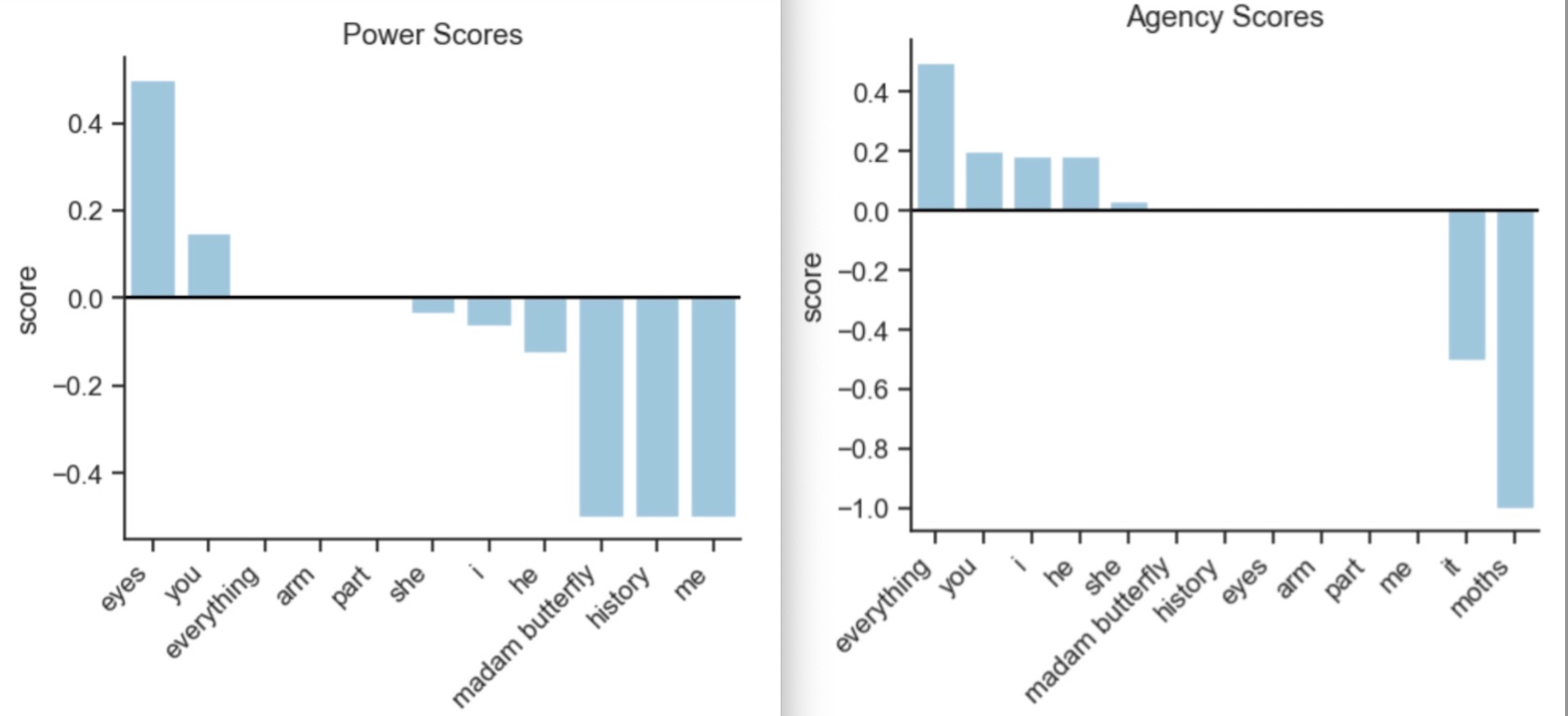
Figure 5. Power and Agency Scores for lettered's Life of Lepidoptra, created by the author using Riveter on December 21, 2023.
Table 5. Evaluation of power and agency scores for lettered's Life of Lepidoptra
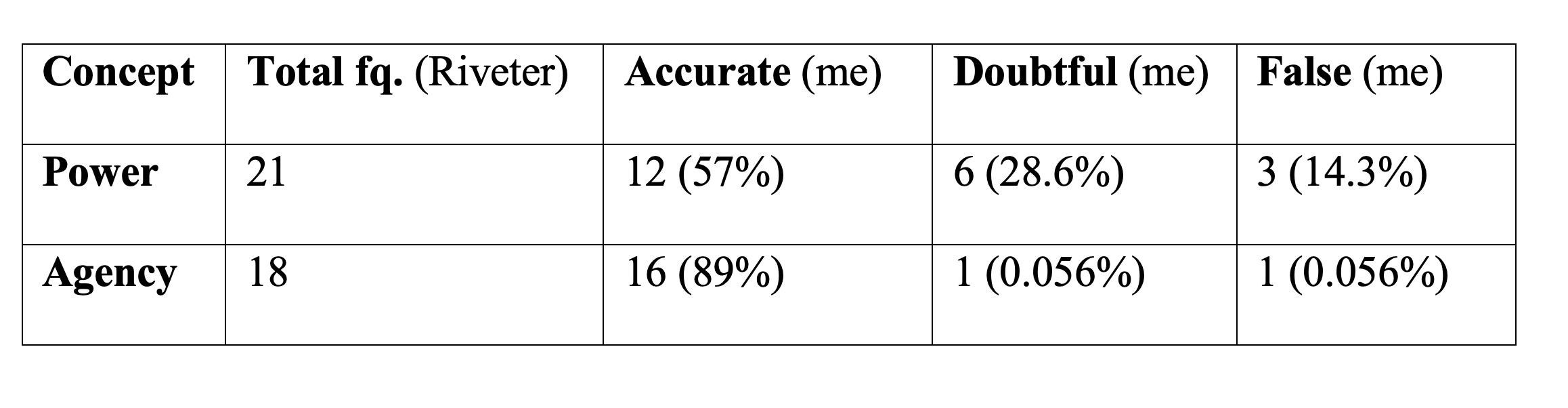
[6.4] Manual annotations of the coreferences and power and agency dynamics in Life of Lepidoptra revealed that Riveter does not work flawlessly. For example, although I agree with the lexicon that the verb "say" usually indicates agency—entities who say something have the agency to speak their mind—Riveter did not score all uses of the word "say." Additionally, although the personal pronoun "you" referred to different entities in different sentences, these were grouped together into the same entity in the scores. Riveter also struggled with polysemy. For example, the sentence "He shakes his head" is scored twice by the power lexicon, once to add to the power score of "he" and once to deduct from the power score of "his head." Because "he" and "his head" are resolved into the same entity at the coreference step—the entity labeled "he" in Appendix 1—these positive and negative scores cancel each other out, not impacting the power score for the entity "he" in practice. I do not consider someone shaking their head as an indicator of their power per se. Other uses of the verb "shake," in sentences like "He shakes her violently." have a different meaning and thus impact the power of the entities involved in a different way. In a sense, Riveter is supposed to detect this difference in meaning, because it evaluates the object-theme-verb triple "he" + "shake" + "his head." However, the software cannot detect that shaking a body part is very different in terms of exerting power than shaking another person.
[6.5] Finally, Life of Lepidoptra raises problems for Riveter because neither Persephone nor Hades are explicitly named in the story. Instead, the Hades/Persephone relationship is tagged by the author in the paratext, and the characters are referred to as "he" and "she" throughout the text itself. While a human reader will understand that "he" and "she" refer to Hades and Persephone here by using information from the paratext to interpret the story, Riveter does not have paratextual information and cannot make deductions of this kind. As such, in the larger analysis of power and agency based on the corpus as a whole, the characters in Life of Lepidoptra have not been linked to the overarching Hades and Persephone entities. Fan fiction's frequent use of intertextuality, paratextuality, and references to fanon and canon to convey meaning make it likely that Riveter missed many of the other references and layers of meaning that rely on fans' existing subcultural frame of reference.
7. Analysis of Life of Lepidoptra by lettered
[7.1] A close reading of Life of Lepidoptra further problematizes the Riveter analysis and illustrates which types of meaning the tool can and cannot capture. Life of Lepidoptra dramatizes the indeterminacy of Persephone's fate. It starts with her expressing anger at being in the Underworld with Hades. Hades's power over her is clear from the beginning, because he lords his all-knowingness over her: "he knows history that hasn't been written yet and loves to tease her for it." And yet the tone of the story quickly shifts, emphasizing that Persephone also felt tempted to taste the food of the Underworld that would trap her there. Her decision to try this food is described as a longing for adventure, for newness: "she wondered whether that swollen ache in her lower half was starving after all, for something new." In the closing lines of the story, it remains unclear to us, and perhaps to the characters as well, whether Persephone chose to spend half her time in the Underworld or was trapped there: "If only you hadn't pulled me down," she laments so often. "My dear," sometimes sardonic, sometimes gentle, "are you sure you didn't fall?" Hades' use of the word "fall" places the power over the situation with destiny rather than with himself. However, considering Persephone's own thoughts about temptation, his words can also be interpreted as a reference to her deliberate choice to join him, a sort of fall from grace. Whether she has power over her own destiny, or Hades has power over her, or fate has power over both of them, remains ambiguous.
[7.2] This ambiguity is further dramatized in the metaphor of caterpillars turning into butterflies that runs throughout the story. Persephone initially calls the Underworld a "cocoon of hell," suggesting that she can never experience growth there. Hades runs with her expression, comparing her to Madame Butterfly, the tragic titular character of Puccini's opera. He also mockingly compares her to a caterpillar because of her "propensity to overeat" and her "propensity to curiosity." He continues the butterfly metaphor, asking: "Has it ever occurred to you that the world above could be a chrysalis?" He then accuses Persephone's mother, Demeter, of smothering her and casts the world of the living as confining her growth. Persephone's own observation, that she was "starving for something new" when she decided to eat food from the Underworld, similarly suggests that it could be the world of the living that imprisons her, while her life with Hades offers freedom and adventure, the opportunity to satisfy the curiosity that Hades sees in her. The story thus offers two oppositional readings of Persephone's character development: either the world of the living is the chrysalis in which she is confined and dependent on her mother, and the Underworld offers her the freedom to fully mature—into a metaphorical butterfly—and be herself, or the Underworld is the "cocoon of hell" that smothers her and keeps her dependent on Hades, while the world of the living offers independence.
[7.3] By presenting these two oppositional readings without resolving them, the story suggests that the power dynamics between characters and the agency of individual characters are not always clear-cut in (fan) fiction narrative. The concept of agency, understood as an agent's power to influence their lifeworld and situation, assumes that an agent has a clear objective in mind. Conversely, Life of Lepidoptra suggests that a sense of uncertainty or undecidedness lies at the heart of Persephone's story: She may not be sure what her desired outcome is, where she most wants to be. Instead of being trapped in the Underworld or forced to be there, the arrangement in which she spends six months with Hades and six months with her mother may best be understood as a compromise, something she has chosen for herself to unite her conflicting desires. Read in this way, Life of Lepidoptra subtly reclaims agency for Persephone by representing her inner struggle and its imperfect solution.
8. Discussion and future work
[8.1] Life of Lepidoptra questions what agency is. By showing how difficult it is for Persephone to determine whether she is in the Underworld of her own free will, the story examines what it means to have free will when people are always dependent—for emotional well-being, social cohesion, and the pleasures and thrills of interaction—on others. Problematizing a real-world concept like agency by representing the interplay between external factors in the plot and storyworld and a character's inner life and decision-making is one of the affordances of literary text. Yet the evaluation indicates that Riveter is not an ideal tool for detecting these subtle mimetic properties of narrative. The tool overlooks both Persephone's undecidedness, which impacts the way her agency can be understood in the story, and the butterfly metaphor, which highlights the tension between Persephone's own power and the power Demeter and Hades hold over her. This suggests that a computational tool like Riveter is not ideally equipped to detect and map all the varied and complex textual tools literary text can use, such as metaphor, doubt or conjecture, allusions, intertextual references, and the tension between interiority and exteriority, to represent and even expand complex concepts such as power and agency. Although fan fiction about Greek mythology may not be representative of fan fiction from other fandoms or literary text more generally, the tool's difficulty dealing with literary language will probably complicate analysis of textual representations of power and agency regardless of the fandom or other textual source.
[8.2] Two interesting—more methodological—avenues for future work concern analysis-scale and character centrality. Text length can significantly impact the accuracy of coreference resolution. In future, it may be fruitful to experiment with the length of text fragments used as input. Additionally, calculating power and agency scores at the level of more individual works of fan fiction may reveal a much wider range of dynamics than the aggregated scores and single case of Life of Lepidoptra can show. Furthermore, the relationship between a character's centrality in a story—whether they are a protagonist or minor character—and their agency is an interesting direction for future research. It is possible that Hades and Persephone entities in the corpus were assigned positive agency scores because the corpus was selected based on their centrality to the narrative; one would perhaps expect main characters to have an important role in advancing their own storyline, which could lead to high agency for those characters compared to others. However, the fact that both Hades and Persephone score relatively low on agency compared to other gods points in a different direction.
9. Conclusion
[9.1] To conclude: Riveter adds a dimension of insight to the analysis of how power and agency are distributed between textual entities in fan fiction texts. Its added benefit lies mostly in the domain of scale, but the tool's findings do not have the robustness and accuracy to stand on their own. Any thorough examination of power and agency in fan fiction should contextualize Riveter scores through selected close reading and a critical engagement with the fandom and the tool's results. Despite these caveats, Riveter does an admirable job of analyzing text on a large scale on the level of semantics—measuring a dimension of the meaning that the texts convey. That Riveter combines an analysis of grammar (operationalized through object-verb-subject triples) with an analysis of meaning (operationalized through the lexicons) presents an important and useful step forward in the applicability of NLP-approaches to narrative text.
[9.2] At the level of individual entities, Riveter may not be ideally suited for textual analysis because, at least in this case, differences in power and agency scores are small. Nonetheless, Hades scores higher than Persephone and most of her pseudonyms, and masculine entities outperform feminine ones on both metrics, indicating a slight gendered power imbalance in the corpus. My close reading of a single work of fan fiction suggests, however, that power and agency operate in more subtle ways in fan fiction than Riveter can detect, particularly through ambiguity and metaphor. As NLP methods continue to evolve, it is probable that Riveter or similar tools will continue to improve at the tasks of entity recognition and coreference resolution. It seems less likely, however, that a lexicon-based approach such as the power and agency lexicons used in Riveter will improve at the task of detecting the subtle ways power and agency are represented in narrative, literary, and fannish texts. For this, we may still need to rely on literary and cultural scholars for the foreseeable future.
10. Data access statement
[10.1] To protect the privacy and anonymity of the fan fiction community, the dataset of fan fiction used to train the Riveter models will not be made available for reuse. However, a limited version of the Riveter models—consisting only of entity groupings and associated scores, with the text chunks redacted—can be accessed and explored using a Jupyter Notebook on Github at https://github.com/julianeugarten/TWC_Riveter.
11. Acknowledgment
[11.1] Many thanks to the amazing lettered for granting me permission to reference Life of Lepidoptra.
[11.2] This research is part of the PhD project Anchoring and Innovating Classical Motifs in Fan Fiction, which is funded by Anchoring Innovation, the Gravitation Grant research agenda of the Dutch National Research School in Classical Studies, OIKOS. It is financially supported by the Dutch Ministry of Education, Culture and Science (NWO project number 024.003.012). For more information about the research program and its results, see the website www.anchoringinnovation.nl.